Regular readers may have noticed that most of the tweed amp in a box pedals seem to be chasing either the legendary 5e3 Tweed Deluxe or the sublime 5F6-A Tweed Bassman sound.
But every now and then, I get a pedal that chases the sound of a 5F1 Tweed Champ. And I think it would help if I had a reference tone to compare those pedals against.
So let’s see what I can put together in the Axe-FX 3.
Table of Contents
- My Pantheon Of Tweed Amps
- What Inspired Me To Look At The Tweed Champ
- Background Reading On The Tweed Champ
- Reaching For The Axe-FX 3’s 5F1 Amp Model
- My Rig Today
- Classic Tones From The 5F1 Amp Model
- Other Discussion Points
- Final Thoughts
My Pantheon Of Tweed Amps
If I had to rank Fender’s tweed-era amps, there are four in particular that I would put right up there in the S-tier:
- 5F1 Tweed Champ
- 5E3 Tweed Deluxe
- 5F6-A Tweed Bassman
- 5F8-A High-power Tweed Twin (HPTT for short)
Everyone’s going to have their own list, and their own reasons for their choices.
My reason’s very simple. Between them, these four amps cover the main tweed-era crunch tones that I enjoy.
- The Tweed Bassman is the classic (and the most timeless, I would argue) tweed-era crunch tone.
- The Tweed Deluxe is perhaps the most iconic of the tweed-era crunch tones.
- The High-powered Tweed Twin (HPTT) has perhaps the most definitive “American” tone of the era.
And what about the Tweed Champ? Let’s dig into that today.
What Inspired Me To Look At The Tweed Champ
Early December, my local guitar store let me know that they now have a Fender ’57 Custom Champ amp in stock – and perhaps I’d like to check it out. (They know me so well – that’s the shop I bought my beloved Tweed Deluxe reissue from!)
So, before going in to try the amp, I thought I’d sit down to learn a bit more about the Tweed Champ amp in general.
Background Reading On The Tweed Champ
My background reading left me with the following things to consider:
- It’s a bit of a marmite amp. There’s a lot of love out there for it, but also a lot of dislike, regret and even outright hatred for it.
- Many of the folks who love it seem to love it primarily as a recording amp. As long as you keep the volume down on the amp (more on that in a moment), it seems to be a very friendly amp to record with. And the recorded audio seems to be very easy to work with in a mix (“it sounds like a record”, as one professional producer said).
- Many of the folks who don’t love it seem to be listening to it directly in the room. You have to crank it to get it to drive, and the drive sound isn’t very pleasant in the room.
- Many folks also find that the cranked amp is too loud for home use.
- Many folks also find the Tweed Champ to be too dark (lacking in top end). Not everyone finds this, though, suggesting that there’s some variance somewhere that affects how different Tweed Champs sound to different people.
- The sweet spot for recording a Tweed Champ is somewhere between 3-6 on the volume control. (The volume control goes up to 12.) This keeps the amp clean, with enough volume to bring the amp to life and to provide enough signal for a mic to pick up.
These is all things I read (or watched) on the Internet, so please do approach it with some skepticism!
My biggest takeaway from all of that is that the Tweed Champ is one of the classic recording amps.
Reaching For The Axe-FX 3’s 5F1 Amp Model
There’s A Tweed Champ In The Axe-FX 3
The ‘5F1’ amp model in the Axe-FX 3 is a Tweed Champ amp model.
I haven’t been able to find any information about the reference amp that was used to create the model. All I know is that it was originally added to the Axe-FX 2, back in November 2013:
Added “5F1 Tweed” amp model based on a Fender Champ. This particular amp exhibits a unique breakup characteristic due to its single-ended design and simple circuit.
Axe FX 2, Firmware 12.00 Release Notes
The real amp has two inputs on it, labelled Input 1 and 2. As far as I know, the 5F1 amp model is based on plugging into Input 1 on the real amp.
Important Caveat: The Axe-FX 3 Isn’t Chasing An Idealised Amp Tone
The whole ethos of Fractal Audio is that they’re trying to produce amp models that are as accurate as possible. Cliff and his team want to digitally recreate everything about an amp; both the good and the bad.
To get that level of accuracy, they’re not going “this is what a Tweed Champ should sound like”. Instead, they’re going “this is what our real Tweed Champ actually sounds like”.
This comes with the implicit understanding that they’re an accurate reproduction of a single example physical amp that the Fractal Audio team have access to.
I imagine that some amp models (like the many Marshall models in the Axe-FX 3) have been checked against more than one real example amp, simply because (due to their popularity) the Fractal Audio team own (or have access to) a few of these amps.
But niche amps (like the tweed amps that I love)? Especially vintage amps (which, by their nature are both rare and expensive)? Unless we’re specifically told otherwise, they’ve probably only been checked against a single example of the real amp.
What does this mean in practice?
The 5F1 model in the Axe-FX 3 is almost certainly going to be a little different to some of the real Tweed Champs that I’ve read about or heard demos of. And there’s no claim that Fractal Audio have based their 5F1 model on a so-called “golden” example of the Tweed Champ.
That said, from what I’ve read, folks who’ve owned both a physical Tweed Champ amp and an Axe-FX feel that the 5F1 amp model is very good.
How The 5F1 Model Compares To A Fender ’57 Custom Champ Amp
Before writing this blog post, I had the chance to try Fender’s current Tweed Champ reissue, the ’57 Custom Champ.
To my ears, the reissue amp that I played is a little brighter than the 5F1 amp model, and has a little bit more gain with a slightly harsher characteristic. Not much in it, and I wonder how they would compare once the speaker on the reissue amp is broken in.
Kristi (she with the golden hearing, compared to my cloth ears anyway) was also there. She vastly prefers the sound of the 5F1 amp model. She found the real amp far too harsh and lacking detail, while there’s a lovely smoothness to the 5F1 amp model when cranked (demo a bit further down).
All of this, of course, is with the caveat that I’m comparing the experience of hearing an amp in the room versus the sound of an amp model through a recording chain. Recorded amps always sound different to an amp in the room.
I think this is especially true when listening to a cranked amp . Even though it’s only a 5 watt amp, the Tweed Champ reissue was louder than I’m used to listening to. I definitely struggled to pick out detail at max volume.
To get a more accurate comparison, I’d need to run a real reissue amp through the same recording chain. Who knows? Maybe that’ll happen in 2026 …
Translating Settings Between The Real Amp And The 5F1 Amp Model
The real amp has a single control: the Volume control. This control goes from 1 to 12. However, the 5F1 amp model in the Axe-FX 3 uses a different scale for the Volume control: it goes from 1 to 10.
(It’s a shame that Axe-Edit doesn’t auto-translate the Axe-FX 3’s internal values to the values found on the real amps. It wouldn’t be difficult to do, and it would add a nice bit of polish to the user experience.)
I’m going to have to translate classic Tweed Champ amp settings from a 1-12 scale to a 1-10 scale for the Axe-FX 3; and vice versa, when I want to go the other way.
To minimise confusion, whenever I’m writing about the Tweed Champ volume, I’ll say something like “3 (out of 12)”; and whenever I’m writing about the volume of the 5F1 model, I’ll say something like “2.5 (out of 10)”.
My Rig Today
The Signal Chain
To avoid unwanted variables, none of these tones are routed out to my pedalboard at all. Everything you’re hearing is:
- guitar
- into Axe-FX 3
- out to my audio interface
- and into my DAW.
If I use any pedals for these initial tones, they’ll all be digital models in the Axe-FX 3, using the Drive block.
Guitar of Choice
Today, I’m playing Jody, my Fender Road Worn 60s Telecaster.
Normally I use Jessie (my 52 Reissue Telecaster) for tweed tones. In this case, though, the Tweed Champ / 5F1 amp model is so dark, I got far better results by using my brightest Telecaster.
Unless noted otherwise, I’m playing on the bridge pickup with both the volume and tone controls on max.
How I’ve Setup The Amp Model
In the Axe-FX 3, I’m using the 5F1 amp model, and I’m only adjusting two controls:
- “Gain”, which is the same as the Volume control on a real Tweed Champ; and
- “Level”, which adjusts how loud the amp block is.
I have to adjust the “Level” to compensate for the volume differences at different “Gain” settings on the 5F1 amp model. If I didn’t, some of the patches would be too quiet to use.
The whole idea here is that I’m trying to avoid “cheating”: I’m not taking advantage of the Axe-FX 3’s immense power to tweak settings that don’t exist on the real amp. What you’re going to hear is how the 5F1 model is meant to sound at stock settings.
This was recorded on Axe-FX 3 Firmware 31.00.
Choosing An Impulse Response
The Axe-FX 3 comes with quite a few stock impulse responses of the Tweed Champ.
After auditioning them, I’ve gone with the 1×12 Little Tweed2 57 C AB impulse response (found as IR #43 in the Factory 1 bank of IRs). I really like how this IR captures those upper mids, while still sounding full without sounding fat or bloated in the low-end.
To help with that, I’ve applied a low cut at 120 Hz in the Cab block, on the IR itself. (Think of this as the equivalent of applying a low-cut switch on the mic itself. Not that an SM57 has a low-cut switch, mind …)
That still produces a surprising amount of low-end, so I’m also applying a low-cut at 80 Hz to the signal coming out of the Cab block. (Think of this as applying a low-cut in the mic preamp.)
I’ve stuck with the 80 Hz low-cut (instead of a more typical 120 Hz low-cut) because I wanted my audio demos to showcase the small-cabinet (ie boxy) sound of the Tweed Champ.
No Post-Processing
All the EQ, delay and reverb that you’ll hear in the audio demos is coming from the Axe-FX 3. I’ve applied no post-processing in my DAW.
I have level-matched the audio before publishing. Here’s how I go about doing that.
I wasn’t going to do any level-matching at first. I really wanted to capture the volume differences between the different amp settings. Unfortunately, the volume differences were just too big in the end.
Classic Tones From The 5F1 Amp Model
Recreating The Recording-Friendly “Volume At 3” Tone
From what I’ve read online, I should set the volume to around 3 (out of 12) on a real Tweed Champ to get a classic, recording-friendly tone. In the Axe-FX 3, that would be the volume on 2.5 (out of 10).
Here’s how that sounds:
I reckon I’ve set the volume a little too low here. I don’t seem to be hitting a sweet spot on this particular amp model. I think it sounds lifeless and uninspiring, and it didn’t feel good under my fingers either.
After some experimenting, I’ve settled on pushing the volume up in the Axe-FX 3 to 3.5 (the equivalent of just over 4 on the real amp) to bring the amp model to life.
Here’s how that sounds:
Now we’re talking! That’s really brought the amp to life. I think it sounds a lot better, and it feels much more dynamic to play, too.
To my ears, though, it still sounds too dark and muddy. That’s easily addressed by throwing an EQ pedal between the guitar and amp. (Pretty sure I got that tip from a forum.)
Here’s a screenshot of what I’ve dialled up:
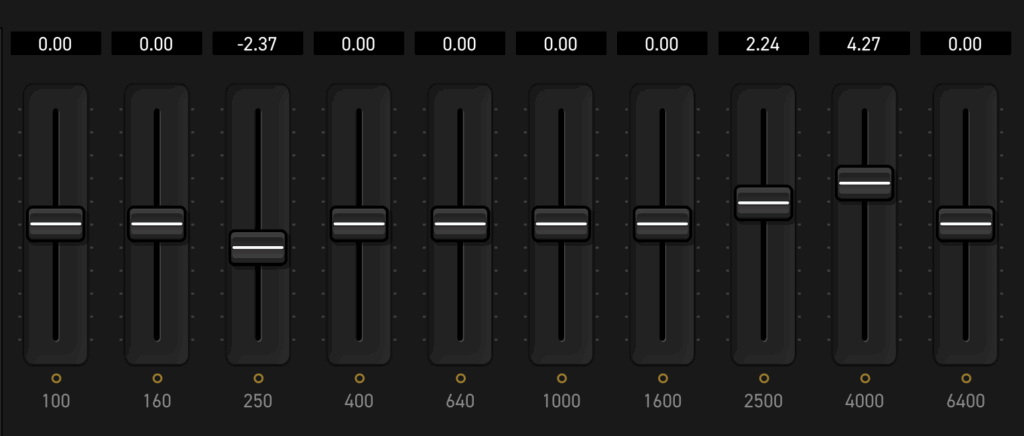
and here’s how that sounds:
I think that’s a lot closer to the sound that I’m used to getting from this Telecaster.
So, what’s it like with pedals? That’s the whole point of running a Tweed Champ with the volume down low: to be a great pedal platform recording amp. Let’s find out.
As A Pedal Platform
Let’s start with my goto: a Klon Klone. I’m using the Klone Chiron pedal model in the Axe-FX 3’s Drive block.
Normally, if I was using a Klon Klone as the main source of dirt, I’d turn the Treble down below 12 o’clock to compensate. The 5F1 model’s so dark, though, that I feel that I need to do the exact opposite.
So, instead, let’s crank that Treble up above 2 o’clock too. Here’s how that sounds:
Holy midrange, Batman! As much as I love the rolled-off note attack that’s typical of tweed amps, that’s taking things a bit too far perhaps. There’s not enough note definition there for my tastes.
So let’s throw on that virtual EQ pedal, to see if that does the trick again. I’m not touching the settings on the virtual Klon klone pedal. Here’s how that sounds:
Well, the note definition is clearly back, so that’s a positive. It sounds a little thinner to me too, probably because the EQ has taken out some of that 250 Hz range.
As a home hobbyist, I’m not used to this kind of sound. Just noodling on my own, I find it quite an uncomfortable sound to listen to. But I’m reminded of advice from professional players, who say that it’s much easier to be heard in a mix if the guitar isn’t big and wide. Maybe this is a sound that I’ll come to appreciate if/when I ever start recording some music.
While I was setting this up, I discovered something else that’s interesting. At such a low volume setting, the 5F1 has a lot of headroom. Even if I max out the volume of the virtual Klon klone pedal, it’s not enough to push the 5F1 into overdrive. It’s the virtual Klon klone pedal that’s doing all the signal limiting / compression, not the virtual amp.
What can I do, if I want less mid-range, but I don’t want to cheat and start tweaking the advanced settings in the Axe-FX 3?
With A Transparent Overdrive
The Tweed Champ / 5F1 amp has plenty of mid-range baked into the sound. Add in the virtual Klon klone’s mid-boost, and the end result is very mid-heavy to my ears.
So what about switching out the Klon klone for a more transparent overdrive, such as a virtual King of Tone pedal? We’ve got one in the Axe-FX 3, so let’s give that a go. I’m going to keep the virtual EQ pedal on, too.
All the energy sounds to me like it’s in the upper mids, while the virtual King of Tone + EQ pedals together have completely cleared out the low mids.
If I go back and forth between the two pedals (virtual Klon klone and virtual King of Tone) …
… I find that I can clearly hear a difference regarding the mids in the two guitar tones.
I’m not sure which one I prefer. I find that the rig with the virtual Klon klone isn’t fun to play, but sounds pretty good on playback, with more mids-saturation than the virtual King of Tone rig.
Maybe I’d be happier without pedals?
Crank That Amp!
This Telecaster that I’m playing has quite a low-output bridge pickup. As a result, the only way I can get the 5F1 amp model to overdrive without using pedals is to crank the amp’s volume to max. That would be 12 (out of 12) on a real Tweed Champ, and 10 (out of 10) on the 5F1 amp model.
Here’s how that sounds:
I think that’s sounding pretty sweet. I just wish there was more note definition; a little more top-end. So, for the very last time, let’s throw on that virtual EQ pedal.
That’s given me the note definition that I wanted. Very happy with that.
This is the point where I’d normally take advantage of the Axe-FX 3’s advanced settings, to finagle (I can’t use the word finesse there, because that would imply skill that I don’t have!) the drive and saturation and overall tone to exactly where I want it.
So, of course, that’s exactly what I did. I’ll post the results in a follow-up blog post.
Other Discussion Points
The Limits Of My Level-Matching Workflow
I’m a little fascinated by how quiet the virtual Klon klone demos sound after I’ve level-matched all of the audio demos, compared to the clean tone demos that came earlier on.
Looking at the audio meters in UAD Console, the driven tones are showing around -18 dB on the audio meter. The clean tone demos also show around -18 dB, but with peaks up going from -15 dB to (occasionally) above -9 dB.
If I ignore the peaks for a moment, even when the clean tone demos are hovering around -18 dB, they sound louder to my ears than the virtual Klon klone pedal demos. Do you find the same thing? Let me know in the comments below.
I don’t normally showcase clean tones on here, so I’ve built my level-matching workflow on overdriven tones. I’m not sure what (if anything) I should change there. For these audio demos, I don’t want to lose the dynamics – I think they’re an important part of what I’m trying to write about.
Final Thoughts
I’ve had a total blast putting this reference tone together. And I wouldn’t have done it, if my local guitar shop hadn’t had Fender’s 57 Custom Champ in stock to inspire me.
Why did I not think to do this before?
That was a great read/listen – thanks ! I own a custom champ ‘57 and really don’t believe it’s 5W at all …. It’s far , far too loud at the higher volume settings for home use for such an innocent looking little amp…. However once it’s warmed up, 4-5 on the volume with single coils and it sounds just the ticket .