
I recently bought a Palmer PCABM.
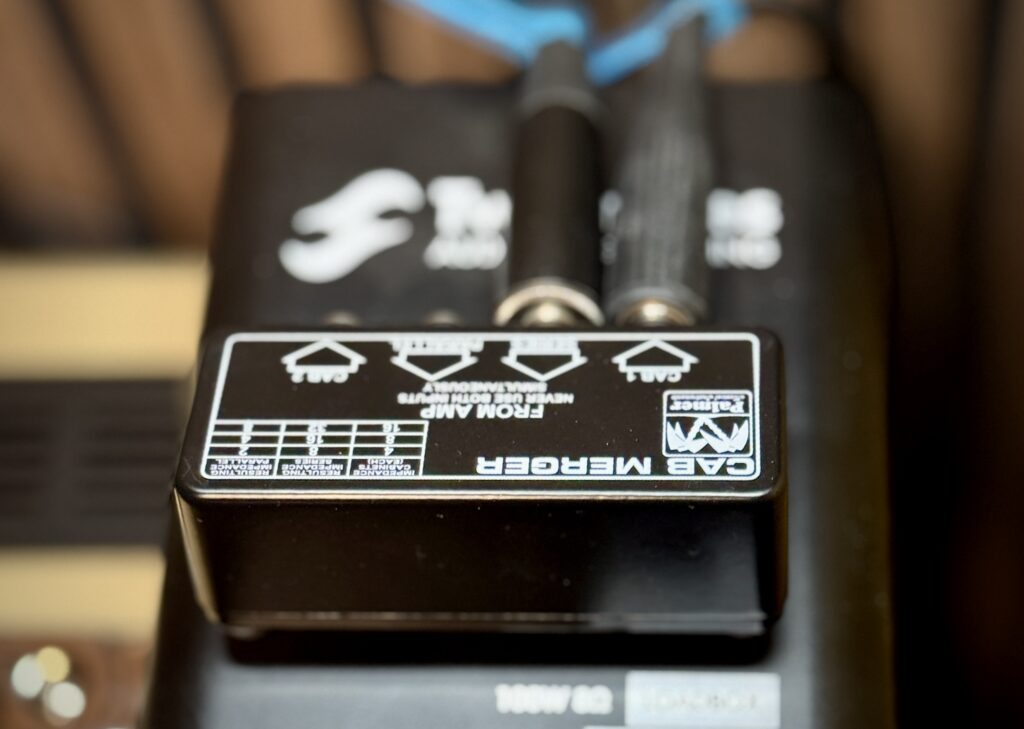
What do I think of it? Here are my first impressions.
What Did You Buy?
I bought a Palmer PCABM.
- “Palmer” is the manufacturer’s name.
- “PCABM” is the product name.
- The “P” in “PCABM” indicates that this is a passive device. It does not require external power at all.
- The “CABM” in “PCABM” indicates that this is a CABinet Merger device.
The Palmer PCABM is a passive speaker cab merger box. You can use it to split your guitar amp’s output between two speaker cabs, either in series or in parallel. It’s a handy utility for any amp where you can only plug one speaker cab in at a time.
It’s a very affordable piece of kit. I bought mine off Amazon for about £25.
Why Did You Buy It?
I’m starting to make regular use of my physical guitar amps. I am regularly plugging / unplugging speaker cables from my attenuators. Last thing I want is to do this too often and end up breaking one of the input jacks on an attenuator.
(Yes, I’m probably over-thinking this, and worrying about nothing.)
Long term, an amp/cab switcher unit is the answer. But that’s in my future. For now, I wanted to get a cheap junction box, and let its jacks take the strain.
Looking around, the Palmer PCABM seems to be the only game in town right now.
- Kemper’s Profiler DI Box can act as a junction box, but mine isn’t sonically transparent.
- Radial make the Cab-Link, but it’s 5 times the price and I can’t find a UK shop that stocks it.
How Does It Sound?
I’ve spent the entire weekend using it with several physical amps into a Two Notes Captor (and, from there, into my silent recording signal chain):
- guitar
- into the Axe-FX 3 (for the tuner)
- out to my pedalboard
- into the front of each amp
- speaker out into the Palmer PCABM
- “series” out of the Palmer PCABM into the Two Notes Captor
- line out into my Axe-FX 3 (for virtual cab, delay and reverb)
- into my audio interface
- and into my studio monitors.
In the room, I can’t hear a difference at all. If the Palmer PCABM is colouring the tone in any way, I haven’t noticed it at all.
A proper test would be to do two recordings (with and without the Palmer PCABM), and then compare them side-by-side. I’ll probably do that at some point for my Studio Diary series.
But so far, I haven’t heard anything that makes me want to.
Final Thoughts
The Palmer PCABM is about 50 times cheaper than the amp/cab switcher that I have my eye on. Sure, it doesn’t stop me from plugging in the wrong cable and accidentally blowing up one of my amps, but my brain finds it reassuring nonetheless. Go figure!
I’ll probably get a second one at some point, to go with my other attenuator.