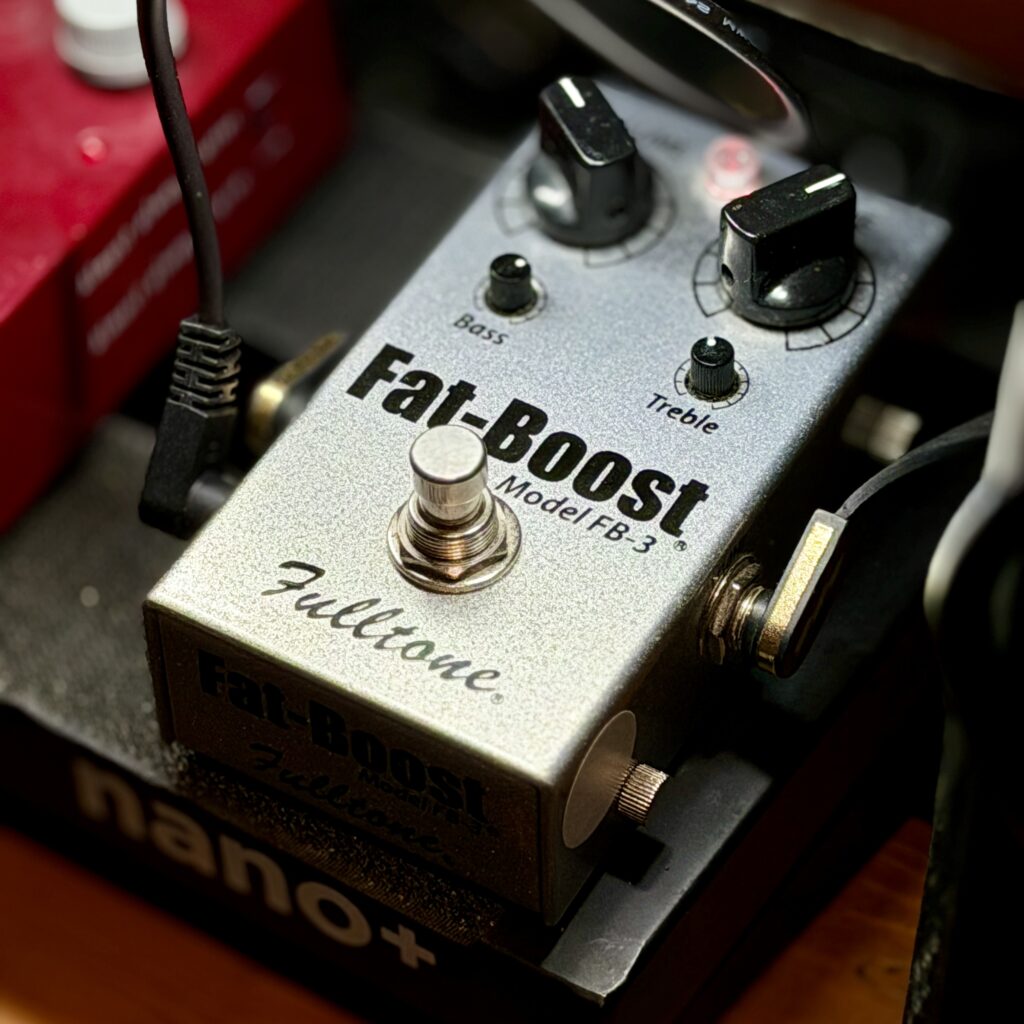
I recently picked up a second-hand Fulltone Fat-Boost FB-3.
What do I think of it? Here are my first impressions.
Table of Contents
- What Did You Buy?
- Why Did You Buy It?
- My Rig Today
- How Does It Sound?
- Other Discussion Points
- Final Thoughts
What Did You Buy?
I bought a Fulltone Fat-Boost FB-3 boost pedal.
- “FullTone” is the manufacturer of the pedal.
- “Fat-Boost” is the name of the pedal series.
- “FB-3” indicates that this is the third version of this pedal.
- “boost pedal” means that this pedal is designed to increase the amount of signal going into the front of an amp or into the next drive pedal in the signal chain.
The FB-3 is primarily a boost pedal. It’s designed to push an amp into natural overdrive by making the guitar’s signal a lot louder. And it’s got a few other features to offer too.
- There’s a two-band EQ (Treble, Bass) for tone shaping.
- There’s a Drive knob for rebiasing the internal FET, which can add harmonics and dirt to the signal.
It’s true bypass, and (as far as I know) it doesn’t include a buffer at all.
It’s worth pointing out that the Drive knob isn’t your typical Gain control. It clicks between fixed positions, and there’s a noticeable (and normal) scraping sound when I turn the Drive knob up or down. This isn’t broken: the Drive knob is actually a bias control, and that scraping sound is expected.
I got mine from the UK second-hand pedal market. It came without the original box, but with the original leaflet. The original leaflet is marked “© 2009”; that’s probably when the FB-3 was first released?
As far as I can tell, no-one is currently making brand new FB-3 pedals. Fulltone no longer manufacture pedals (after Mike Fuller’s deplorable remarks in 2020). Jackson Audio licensed Fulltone’s designs back in 2023, but – at the time of writing – I don’t see the FB-3 listed on the website.
I haven’t been able to find anyone who makes a clone of the FB-3 either. Second-hand seems to be the only option right now if you want one yourself.
Why Did You Buy It?
I’ve seen the Fulltone FB-3 appear on “tweed-tone pedal” lists and forum threads. Tweed-tone pedals are firmly my thing, so I wanted to check it out.
I also like checking out interesting boost / tone-shaping pedals.
- I’m a great believer that stacking pedals (or pedals into amps) is a great way to find your own tone and avoid sounding exactly like everyone else.
- They’re also great tools if you like switching between different types of guitar.
Even if the Internet is wrong about it being a tweed-tone pedal, there’s a good chance that it’ll be a good boost pedal.
My Rig Today
Today, I’m playing:
- my guitar
- into my Axe-FX 3 (for the tuner)
- out to my pedalboard
- into the Synergy Imperial MK2 preamp
- back into the Axe-FX 3 (for virtual power amp, cab, delay and reverb)
- out to my audio interface
- and into my DAW.
For guitar, I’m playing Ghost, my 2015 Gibson Les Paul Custom fitted with a set of Sigil Pickups Bluesman Roots pickups.
On the pedalboard, I have the FB-3 in one of the loops of my trusty Gigrig G2. This makes sure that any other pedals on my board can’t colour the signal in any way when I’m not using them.
I’ve gone with the Synergy Imperial MK2 preamp today because of its dual character:
- the rhythm channel (the green channel) is voiced like famous Fender blackface-era amps, and is widely recognised as a great pedal platform,
- while the lead channel (the red channel) is voiced more like a modern interpretation of a tweed amp, which makes it an interesting test platform for boost pedals.
My Synergy Imperial MK2 preamp is housed in a SYN-1 enclosure. I’m using the main input on the front of the SYN-1 enclosure, and the main output on the back of the SYN-1 enclosure (ie, I’m not using the SYN-1’s 4-cable-method ports).
For virtual speakers, I’m using two sets of Celestion’s official IRs:
- Vintage 30s for the Imperial MK2’s rhythm channel,
- and a blend of Celestion A-Type and Celestion Blue for the Imperial MK2’s lead channel.
I’ll make sure that the caption for each audio demo clearly lists which IRs I’ve used.
All the delay and reverb that you hear are from the Axe-FX 3 (which is running firmware 32.03). I’ve applied no post-processing at all. I do level-match my audio demos before publishing, but that’s all I do to them.
How Does It Sound?
As A Drive Pedal Into A Clean Amp
First off, here’s how the guitar and amp sound on their own:
I’ve found that many lower-gain drive pedals don’t come alive until I turn their gain knob up past noon. So let’s start the FB-3 with these settings:
- Drive at 1 o’clock (first notch past noon)
- Volume set roughly at unity (around 10 o’clock)
Here’s how that sounds:
To my ears, the FB-3 has added a lot of clarity and just a hint of grit when I dig into the top strings on that G major chord. I think that sounds a lot better than the amp did on its own.
And I really do mean just a hint of grit. The FB-3 is surprisingly clean at this setting. It’s clearly not your typical overdrive (nor was it marketed as one).
Hrm … but the Interweb forums do tout this as a tweed-tone drive pedal …?
Let’s turn the Drive up to 3 o’clock, and hear what happens. Most overdrive pedals start to turn into mush machines around this point. The FB-3?
When I was recording this, it sounded far too clean to my ears. Listening back? I’m hearing a soft, low-gain and tweed-like drive that would work as a rhythm tone.
I particularly like how it’s rounding off the top-end of the amp & virtual cab combo. That’s one of the key tonal features that I look for from my tweed tones – and it’s something that (IMHO) the Synergy Imperial MK2 can’t do without help.
Alright, let’s see what this pedal has. I’m going to turn the Drive up to its max setting at 5 o’clock next:
I did not enjoy playing through this. During recording, it sounded too fat and boomy where I sit to play, and I really felt the loss of dynamics.
Listening back is a completely different experience. I could easily imagine that this is a sound that many guitarists would like, and could make good use of.
I still wouldn’t go for this sound myself. Can you hear noise and pops that are poking through the playing at seemingly random spots? I know they’re there, and it puts me off. There’s a harshness to it that isn’t for me. The internal FET is just being driven too hard at this setting, I think.
(And this is with low output, vintage-voiced pickups, which you don’t typically find on most guitars.)
Unlike a typical drive pedal, the FB-3’s Drive control isn’t a fully-variable pot. Instead, we’re limited to fixed positions. So hopefully 4 o’clock will be a happy medium?
Maybe I’ve been spending too long with Marshalls and Fender Deluxe Reverbs recently, but that right there is a fairly convincing tweed-tone to my thirsty ears – especially considering it’s going through Celestion V30 impulse responses.
All in all, I’d say that it can be used as a drive pedal … it’s just that I think it’s truly special when used as a boost pedal.
As A Boost Pedal Into A Dirty Amp
Let’s switch over to the Synergy Imperial MK2’s lead channel next, and reconfigure the Fulltone FB-3 to act as a boost for this amp.
While the rhythm channel is quite similar to famous Fender blackface amps (especially when kept clean), the lead channel really is its own thing. It’s tweed-like, falling somewhere between the 5e3 Tweed Deluxe and the 5F6 Tweed Bassman in my opinion, but with its own twist. Given the popularity of the original amp (the Tone King Imperial MK2), I think it’s fair to describe it more as modern-voiced tweed tones for people who don’t like vintage-voiced tweed amps.
As before, let’s start by hearing the amp on its own. This time, I’m playing in the middle position of my Les Paul (where the magic is!), and I’ve switched cabs over to my preferred tweed-tone mix of Celestion A-Type and Celestion Blue IRs.
I’m playing a Les Paul Custom, which is nowhere near as honky as a Les Paul Standard, and yet the mid-range in that recording seems to be so nasally. I suspect that’s down to the way the amp is reacting to the extra low-end being added by my Les Paul’s neck pickup.
Now, let’s add the FB-3 back into the mix. I’ve turned the Drive control back to 1 o’clock (first notch past noon), and I’ve turned the Treble up slightly to compensate for the darker sound from my Les Paul’s middle position.
We’ve already heard this setting on the FB-3 into a clean amp, where it added clarity and the tiniest bit of grit to the tone.
To my ears, that’s exactly what it’s doing here, into the already dirty lead channel of my amp. It’s shifted the tonal balance back towards the mid-frequencies, making the amp sound far more vintage-voiced than before. The dirt sounds a little softer to me too, which I find far more pleasing.
This, for me, is well worth what I paid for this pedal.
Other Discussion Points
Let’s Talk About The Noise On The Recordings
If you’ve listened to the audio demos all the way through, you probably noticed a crackling noise at the end of each recording.
That definitely isn’t caused by the FB-3. It’s present on this audio demo (which doesn’t use the FB-3 at all):
as well as this audio demo (which does use the FB-3):
Does the FB-3 amplify electrical noise a little, even at around unity gain? I don’t know. I can’t tell.
If I turn the FB-3’s volume up, to push more signal into the amp, then yes … that is going to amplify existing electrical noise by definition. Pretty much every boost pedal I’ve tried would do the same thing.
It’s not a fault of the pedal at all.
I Was Worried It Was Faulty At First
When I first got it, it didn’t seem to be fully working:
- when the pedal was bypassed, there was no sound going through it
- the pedal sounded thin and very quiet when engaged, even with the volume cranked
I popped the back off the pedal, and took out the battery that the previous owner had left inside. That definitely sorted the second issue. I’m pretty confident that the pedal now sounds exactly like it was designed to.
The first problem? As the pedal is currently working (and sounding great!), I’m just going to my trusty Gigrig G2 to bypass the pedal when I’m not using it. This is how I’d use the pedal anyway, so as long as it continues to work, I’m happy with what I got for my money.
These things happen with second-hand pedals. By and large, they’re consumables with very limited repairability (due to parts shortages, and how fiddly some of them are to work on).
That’s why I always try to frame these blog posts as talking about the specific unit that I’ve bought, and try to avoid talking about (for example) all FB-3 pedals that are out there.
Final Thoughts
I think my Fulltone FB-3 excels as a boost / tone-shaping pedal into an amp that’s already cooking. To my ears, when I use it as a boost, it has that it factor that makes it stand out from other pedals.
As a tweed-tone drive pedal … while I agree that it does sound tweed-like, it’s a surprisingly harder sell for me. Regular readers may recall that I normally love to have options. In this case, I don’t see me reaching for this pedal to be a drive pedal very often.
I’ve got to turn the FET bias up to 4 o’clock to get a sound that works both during recording and during playback. 3 o’clock is too soft to enjoy playing through, and 5 o’clock is too harsh for my tastes (and it can’t help but reveal the electrical noise I have here at home).
I’m sure it’d be a different story if I used a guitar with hotter pickups, so don’t let my experience decide for you.
I just think the sweet spot on this particular pedal is at the 1 o’clock setting, before it starts overdriving all the time.
That, for me, is where the magic is in this pedal, and I’m very alright with that.