I recently bought a BJFe Flame Top overdrive pedal.
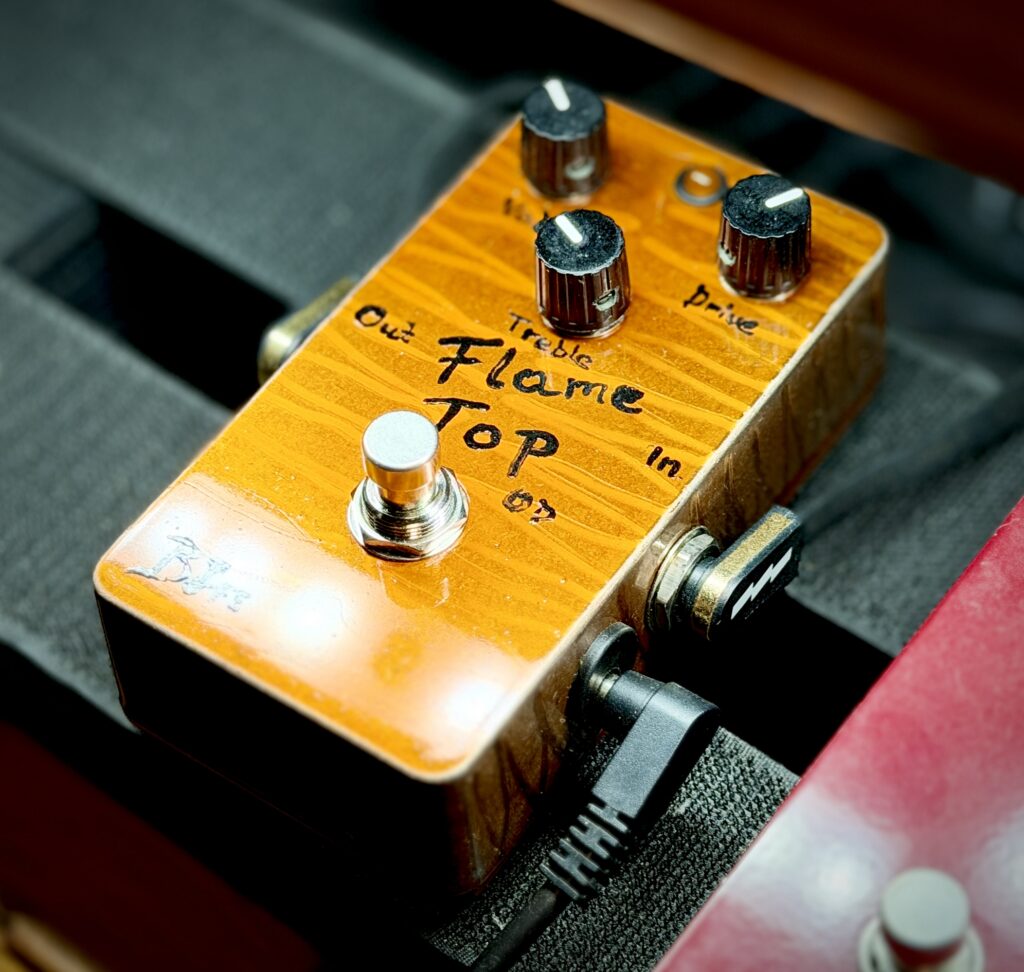
What do I think of it? Read on for my First Impressions.
tl;dr
The BJFe Flame Top by Björn Juhl is one of my bucket-list pedals. It’s my understanding that it is the prototype circuit for the Mad Professor Sweet Honey Overdrive (SHOD for short). The SHOD has been my #1 drive pedal for over a decade.
To my ears, the Flame Top features more treble and less low-end than a standard Sweet Honey Overdrive. This makes it a very useful option for darker guitars and playing in the middle or neck position on fatter-sounding guitars.
In my opinion, the Flame Top offers exceptional note separation. I can’t think of a drive pedal that offers better.
It’s probably going to become my #1 drive pedal for my Telecaster. It’s too early to say whether it will displace my SHOD as my #1 drive pedal for all guitars.
What Did You Buy?
I bought a BJFe Flame Top overdrive pedal.
- BJFe is the brand. This indicates that the pedal was designed and made by the legendary pedal designer Björn Juhl.
- Flame Top is the name of this particular pedal. (It’s sometimes referred to as Flametop too.)
- overdrive indicates that this pedal (probably) uses soft clipping (rather than hard clipping).
The BJFe Flame Top is an overdrive pedal from my all-time favourite circuit designer, the legendary Björn Juhl. This is a hand-wired pedal. I believe it was made by Björn himself and hand-painted by his wife.
I haven’t been able to track down Björn’s own description of the Flame Top, so I cannot record any manufacturer’s claims here.
I bought mine brand new from These Go To 11 via Reverb. I imported it from Sweden, and had to pay import charges on top of the original price. Dispatch was same-day, and it arrived three days after ordering. Very happy with that. That’s quicker than ordering from many UK businesses!
Why Did You Buy It?
The Flame Top is a bucket list pedal for me.
Björn designed my all-time favourite pedal: my beloved Mad Professor Sweet Honey Overdrive (SHOD for short). My understanding is that the Flame Top was the prototype circuit for the SHOD. (See also “Flametop” on the official BJFE forum.)
- Are they the same?
- How do any differences affect my tone and how I approach playing?
- Will I prefer the Flame Top? Will it become my new #1 drive pedal?
I’m looking forward to finding out.
Those questions are for a follow-up blog post, where I’ll put both pedals side-by-side on my pedalboard. Today, I just want to try the BJFe Flame Top and get to know it a little bit.
My Rig Today
Today, I’m playing:
- guitars,
- into the Axe-FX 3 (for the tuner),
- out to my pedalboard,
- back into the Axe-FX 3 (for virtual amp, cab, delay and reverb),
- out to my audio interface,
- and into my DAW.
I’ve ended up using a few different guitars for the audio examples:
- Jody, my all-stock Fender Vintera II Road Worn white guard Telecaster,
- Mirage, my all-stock Fender Postmodern 63 Telecaster with a neck humbucker, and
- Deadnote, my all-stock PRS McCarty 594 – my #1 guitar when I’m using my beloved Sweet Honey Overdrive pedal.
The plan was to use only Deadnote, but (as I’ll hopefully demonstrate further down), the BJFe Flame Top is a very interesting pedal for Telecasters too.
On the pedalboard, I have my Klon KTR, my MXR Duke of Tone, my Sweet Honey Overdrive, my BJFe Honey Bee OD Retro (HBOD-R for short) and the BJFe Flame Top in separate loops of my trusty Gigrig G2. The Gigrig G2 makes sure that a pedal cannot affect the tone when I’m not using it.
In the Axe-FX 3, I’m running my own HTB 15 Vintage pedal platform preset. I’ve designed this preset to bring the best out from tweed tone pedals. The Axe-FX 3 is running Firmware 32.06, which was released back in July 2026.
All of the delay and reverb that you will hear is coming from the Axe-FX 3. There’s no post-processing (EQ, compression) applied at all. I will have level-matched the audio clips before publishing them.
How Does It Sound?
A Little Treble Goes A Very Long Way
The very first thing I noticed with the Flame Top is just how bright it is.
With my Telecaster, I only need to put the pedal’s Treble control to around 10 o’clock, even when I’m on the rather dark neck pickup.
If I move to the Telecaster’s bridge pickup, leave the guitar’s tone control wide open, and leave the Flame Top’s Treble control around 10 o’clock, I get a tone that’s very cutting:
The answer is to roll the Telecaster’s tone control down a bit, rather than adjust the pedal. That gives me a very nice bridge pickup tone, and the option of switching pickups without having to touch the pedal at all:
To my ears, the Flame Top sounds bright partly because it’s not producing much low-end at all. On this particular Telecaster, which has a very dark neck pickup, that really works for me.
It reminds me a lot of the way we have to adjust the Presence control on Wampler’s fantastic Pantheon pedal. The advice there is to start with no Presence, and then gradually bring it in until you have just enough.
I’d say that the same advice applies to the Flame Top’s Treble control. Small moves, Ellie, small moves!
The Treble Control Is A Boon For Playing In Middle Position
I have a strong preference for playing a Les Paul (or a similar guitar that has two humbuckers) in the middle position: both humbuckers on at once. That’s often where the magic is for me, especially if the guitar has separate volume and tone controls for each humbucker.
Problem is, my guitars start to sound dark very quickly as I start to turn down the bridge humbucker’s volume. Not only does that end up sounding dull, but many overdrive pedals rely that disappearing treble content to create their distortion sound.
I’ve found that the Flame Top’s Treble control is fantastic for this exact situation.
I can dial in my guitar the way that I want it, and then make small tweaks to the Treble control on the Flame Top to keep the overall guitar tone sounding present:
That’s huge for me.
I’ve tried compensating for missing treble further down the signal chain in the past, and I’ve learned the hard way that I don’t like the results so much. As a general rule, the earlier in the signal chain that I can “fix” tone issues, the happier that I am.
It’s one of the big reasons why I normally run my Klon KTR in front of my main drive pedal: to ensure the top-end doesn’t sound dull when I’m using my Les Paul or Deadnote. Not entirely sure that’s going to be necessary with the Flame Top. I’ll come back to that further down.
Sounds Very Open With My Telecaster
The other thing that immediately struck me was the note separation. Let’s go back to my Telecaster to try and demonstrate what I’m experiencing.
I think that the Flame Top has exceptional note separation. Off the top of my head, I can’t name a pedal with better.
I can easily see this being my go-to pedal for clean-ish neck pickup playing, or anything where I want to emphasise picking melodies and interest out of chord progressions.
It’s such a joy to use for that kind of playing. Although I’d probably pick a guitar that intonates a lot better than Jody currently does!
That’s the one downside to this: there is nowhere to hide.
It’s not just the notes that sound so clear; every mistake, every bit of poor technique, every bit of bad tuning and every intonation problem is front and centre too. I think I managed to capture all of those in the audio clips above!
I don’t really think that it’s a downside … more that, a few years ago, I wouldn’t have had the confidence to enjoy playing through such a revealing pedal. I’m a bit more forgiving of my mediocre guitar playing these days.
Shelves Off A Bit Of Low-End
The more I use this pedal, the more I notice that it’s dumping some of the low-end from the guitar.
Exactly how much? The easiest way to demonstrate that is to switch over to Mirage. This Telecaster has a neck humbucker which produces a lot of low-end. It normally sounds very muddy through my rig, unless I add some pre-EQ via the Axe-FX 3.
How does the Flame Top handle this?
I’m a little surprised by the final result there. While the Flame Top has removed enough low-end to make Mirage usable, I’d probably be happier if I took out a little more low-end.
Compare that to the AnalogMan King of Tone and the MXR Duke of Tone. Both of those pedals cut down on low-end even more than the Flame Top does, in my experience.
Let me quickly grab the Duke of Tone to show you what I mean.
I still remember my shock at this, when my King of Tone first arrived. It’s fair to say that I was not a fan! It’s only in recent years – thanks to Mirage and my PRS Paul’s Guitar – that I’ve come to appreciate pedals that can handle guitars with plenty of low-end.
Does It Klon?
Yes. Let’s stick with Mirage for this:
For contrast, here’s a reminder of how this signal chain sounded without the Klon KTR:
I had to be very careful with the Treble control on both pedals. I found it very easy to add too much treble between the two pedals, creating a tone that was far too harsh for my tastes.
I’m on the fence about boosting the Flame Top with a Klon or a klone.
- I normally boost my beloved SHOD with my Klon KTR to add a bit of clarity and top-end. The Flame Top already has that in buckets.
- At the same time, my Klon KTR is also shaving off some of Mirage’s excess low-end before the signal reaches the Flame Top. I think that is an improvement.
I’m going to need a lot more time with it (and with my SHOD) to figure this one out. Speaking of my SHOD …
How Does It Compare To The Sweet Honey Overdrive?
I know I said I wasn’t going to do this today. I just couldn’t help it.
It’s been months since I’ve had the Sweet Honey Overdrive on the board, and my signal chain has changed during that time. So I ended up grabbing the latest handwired version of the Sweet Honey Overdrive, just to refresh my memory.
To my ears, the family resemblance is there, especially in the gain structure. There are differences, though.
- I reckon the Flame Top is cutting a little more low-end, has better note separation, and a bit more top-end bite to each note.
- The SHOD is a little sweeter, perhaps, with a more rounded note attack, and a little fuller.
I will post a proper side-by-side comparison of both pedals in the future. I’ll also throw in some of the SHOD variants that Mad Professor has released over the years.
How Does It Compare To The BJFe Honey Bee?
The Honey Bee is arguably Björn’s most famous design. How does it compare to the Flame Top? I’ve quickly grabbed my BJFe Honey Bee ODR to find out.
Compared to the Flame Top, I think that the Honey Bee is darker, retains far more of the guitar’s natural low end, and has a lot less gain available. I also have to turn the Honey Bee’s volume up further to match the Flame Top’s output level.
(Also interesting how my level-matching tool has made the Honey Bee audio sound much louder than the Flame Top audio …)
I’d argue that the Honey Bee simply has a more neutral EQ; it’s letting more of my guitar’s original tone through than the Flame Top does. The Flame Top (like my beloved SHOD) shapes the guitar tone quite a bit, and has more mid-range saturation to it too.
I’ll post a proper side-by-side comparison of these pedals too in the future.
Final Thoughts
I’m delighted with the Flame Top. It’s an even better pedal than I hoped for.
This pedal gives me another flavour of the Sweet Honey tone family. Regular readers know how much I love having options. And, in this case, it’s an option I think I’ll use quite a lot.
I can easily see the Flame Top becoming my #1 drive pedal for my Telecasters. That note separation and clarity – along with the low-end cut – is just perfect for neck and middle positions.
It’s a keeper for that alone.