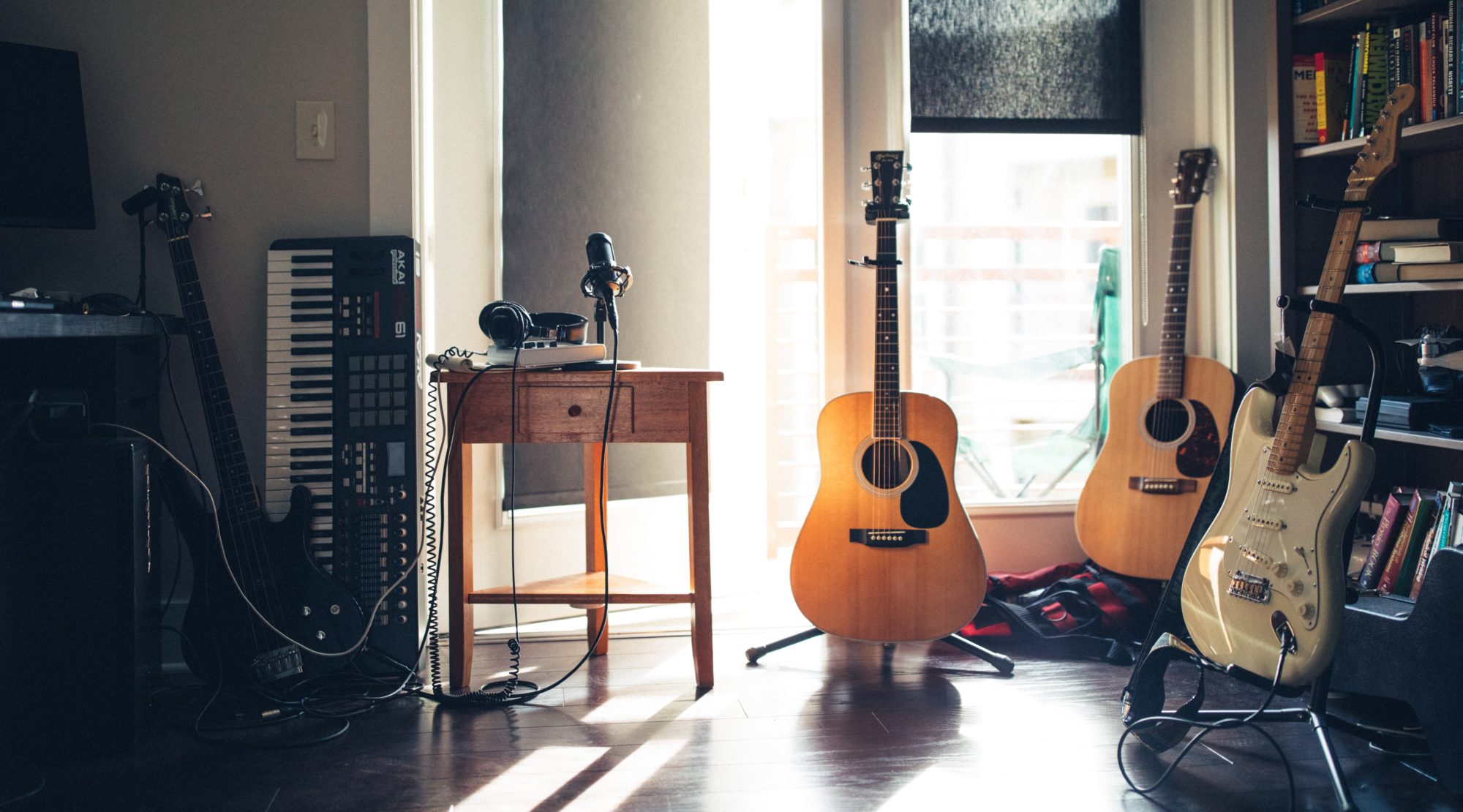
My Gear For The Acoustic Gigs

My mind is on the upcoming acoustic gigs we’re doing. I haven’t gigged since 5th May 1992 (funny how that date has stuck in my mind). That’s so long ago, I’m effectively gigging for the first time.

I thought it’d be useful (both for me and anyone else looking to move out of the bedroom and onto any kind of stage) to talk about the gig, the rig, and any lessons that come out of actually doing it.

The Act

We’re starting off as a two-piece semi-acoustic act. Tess is on vocals, and I’m on guitar. Why have we gone for this format / approach?

Long and short of it … we’re hoping that it’ll be much easier to gig regularly as an acoustic act. It’s an act that scales down nicely to small venues / bars / cafes and the like. There’s a lot more of those than venues that can accommodate a five-piece rock machine with a live drummer.

The Guitars

The main guitar for our set will be my Fender Acoustasonic Telecaster. I’ll also be using my Taylor T5z during the set.

Originally, my Taylor T5z was going to be the main guitar for this band. I bought it back in 2017 exactly for that purpose. Then the Acoustasonic Tele came out, and that changed everything.

The AT simply sounds much better at the acoustic thing, thanks to the onboard Fishman modelling. And it’s eminently more replaceable should the worse happen at a gig.

But the Taylor isn’t completely out of the picture.

Seeing as I already have it, it’s coming along to be my backup guitar (just in case). And we’re using it for one song in the set. One of the songs requires an alternate tuning. During rehearsals, we decided that it’s too much faff to retune the AT, so we’re going with the T5z already retuned for that one song.

If we manage to land more gigs, I’ve already decided to get a second Acoustasonic Tele to be the backup / alternate tuning guitar. The set list and arrangements are all built around how the AT sounds and plays. It just makes sense to be able to have a like-for-like as the backup guitar … eventually.

The Amps

Here, I need to give a huge shout out to the wonderful folks over at AStrings. They let us come in for a couple of mornings and audition every single acoustic amp in stock, using our own gear. I’m so grateful that they did, because there was one amp in particular that stood out as perfectly suiting our sound.

We’re using a pair of Acus One 8 acoustic guitar amps.

These are 4-channel solid-state amps. Each channel has its own separate preamp controls. I’ve set one channel up for the AT, and a second channel up for the T5z. All I’ve got to do during the gig is remember to zero the channel volumes when switching guitars 🙂

We haven’t decided yet whether we’ll run Tess’s vocals through the same amp (which does sound great), through the 2nd Acus One 8 amp, or straight into the venue’s PA. We’ll sort that out on the night.

The main reason for having two Acus One 8 amps is to make sure we’ve got a spare with us.

Other Items

There’s a few other things I need to take along with me to the gigs: tuner, capo, and guitar picks. Oh, and instrument cables!

Atm, I’m using TC Electronic Polytune headstock tuner. I need to put a fresh set of batteries in before the first gig. And a spare wouldn’t hurt at all. If only they weren’t out of stock right now …

In the back of my mind, I’m wondering if I should be using a floor-based tuning pedal as well or instead? A floor-based pedal would also give me a kill switch. That might be useful.

Things I’m Not Using

For now, I’ve decided against putting together a pedal board for acoustic gigs. There’s a couple of reasons why.

My instinct is that I don’t want to be worrying about power-related problems at gigs. I just want to plug straight into the amp, and not be worried about finding somewhere to plug in the pedal board – or be worried about someone somehow unplugging it during the gig.

I’m open to the idea of using a small board with all the pedals running off batteries. Unfortunately, I haven’t found many pedals that run off battery and work with acoustic guitar tones. Especially compressors, which is the main effect I’m interested in.

With Brexit looming – and the likelihood of supply chains being disrupted for months afterwards – I probably need to make a final decision on this in the next couple of weeks. I might be better off getting the pedals that I can whilst they’re available, and then selling them on if I end up not needing them.

A pedal board that includes an acoustic DI box might also come in handy for travelling light – just guitar and nano pedal board.

tBone IEM200 In-Ears Monitoring Demo

Henning Pauly has posted a behind-the-scenes look at the setup for his recent live band live streams, showing us the in-ear monitoring he’s been using for the live bands.

You probably won’t ever need an in-ear monitoring system for home playing or home recording. But if you’ve got a band that rehearses or plays live, you need something that’ll protect your hearing and let you hear everything that’s happening.

Please head over to YouTube to leave a like and a supportive comment.

The Realities of Touring

Mary Spender has recently completed a UK tour, where she was also the tour manager and (at least part-time) promoter … and she’s posted a vlog to show us what it was really like.

The thing I loved about this was how Mary shows us that it is possible to take music on the road and put on your own tour in this day and age. If you can draw a crowd, keep things minimal, and organise things yourself, the dream is in reach.

Watch the video for the whole story, and then please head over to YouTube to leave a like and a supportive comment.

Leo’s Shuriken / Helix Live Setup

Leo from Frog Leap Studios has posted a demo of his Line 6 Shuriken Variax, and how it enables him to perform his famous metal covers live.

It’s really cool how far the Variax has come from the early days. I had the original Variax – boy was that a long time ago – and it was so bad it ended up in the recycling. I couldn’t even give it away. But the Shuriken – especially paired with the Helix – looks worlds apart. Check out Leo’s video to see just what it can do.

Please head over to YouTube to leave a like and a supportive comment if you enjoyed Leo’s video.

Fender Reliced Guitars Discussion

Ariel and Danish Pete are back with another Guitar Paradiso. This episode, they’re looking at reliced Fender Custom Shop Stratocaster.

This one quickly turns into a wide-ranging discussion about the whole concept of relicing Fender guitars, how different guitar finishes do (and don’t) wear over time, and why a reliced guitar might be a good choice.

Both Ariel and Pete are hugely experienced touring musicians, and it’s great to hear them sharing their experiences and personal preferences. Along the way, Pete digs out several of his personal Strats to help demonstrate the points he’s making, including guitars that he’s toured all round the world.

Please head over to YouTube to leave a like and a supportive comment if you enjoyed this Andertons video.

Kammer TinyK Pedalboad Amp In A Produced Track

Henning’s just put up a quick demo of a very interesting piece of gear – a 40W that sits on your pedalboad. Not a drive pedal – a full-blown amp, complete with FX loop!

If you’re a gigging musician, having a backup amp of some kind is essential – especially if you gig with real valve amps. Lugging a spare amp around isn’t fun. And depending on what you buy, that’s a lot of money tied up in it, especially as you hope to never actually have to use it.

Some kind of backup that can sit on your pedalboad – just in case – has a lot of appeal.

And for us home tone chasers, if you can’t have / don’t want a traditional amp at home, this kind of thing is well worth looking at as an alternative to using modelling amps or software amp sims.

I’ll post the full review when Henning uploads it. This could be one to watch.

Please head over to Henning’s channel to leave a like and a supportive comment if you enjoyed Henning’s video.

Metallica’s Guitar Rigs From Sept 17

This is a very interesting video. It’s a walkthrough of the guitar rigs used by Metallica’s James Hetfield and Kirk Hammett.

Okay, here at the HomeToneBlog, we’re playing to an audience of one – not touring the world playing to arenas full of adoring fans hanging on every single note. There’s still a lot we can learn from seeing what the pros use – and why.

Two things in particular caught my eye in this video.

First off was that Metallica have gone entirely digital modelling for their live amps. The AxeFX has reached the point where it sounds good enough to replace tube amps – and whatever difference there is, it’s not big enough to be worth the challenges of using tube amps.

There’s a telling statement from James’ guitar tech partway through, where he discusses how using AxeFX means they have more time to spend on other aspects of the touring process, like guitar maintenance. Digital modelling promises to sound the same night after night. Tube amps don’t.

Kirk’s guitar tech also throws some light on that decision. He talks about how each tube amp has its own character, and what it can be like when you have to switch to a backup amp when the primary tube amp dies.

The second thing that stood out for me was how they’ve gone with analogue signal paths and switching. Mid-song, they don’t switch patches inside the AxeFX; they switch to a different AxeFX that has the next patch already loaded and ready to go. Why? Analogue just doesn’t have any added latency. Switching is instant.

Something to think about if you’re thinking of gigging with a digital amp yourself one day.

Top 5 Microphones For Singers

Over on their YouTube channel, mega-European retailers Thomann have taken a look at 5 great dynamic microphones for singers.

Here’s the list of the microphones covered:

  1. Audix OM-7
  2. Audio-Technica AE 6100
  3. The T-Bone MB85 Beta
  4. Sennheiser E945
  5. Shure SM58

You get to hear both talking and singing through each microphone. Very cool.

Please head over to YouTube to leave a like and a supportive comment if you enjoy Thomann’s video.

Divided By 13 FTR37 Demo

Back in January, Rhett Shull posted a demo of his Divided By 13 amp, the FTR37. Even if you’re not interested in the amp, it’s worth watching the video just for the opening track.

I’ve seen Divided By 13 amps on a bunch of YouTube demos over years, especially Shawn Tubbs’ videos. They have a striking design, and seem to be an amp of choice for pros. Definitely curious to learn more about them whenever I can,

Please head over to YouTube to leave a like and a supportive comment if you enjoyed Rhett’s video.