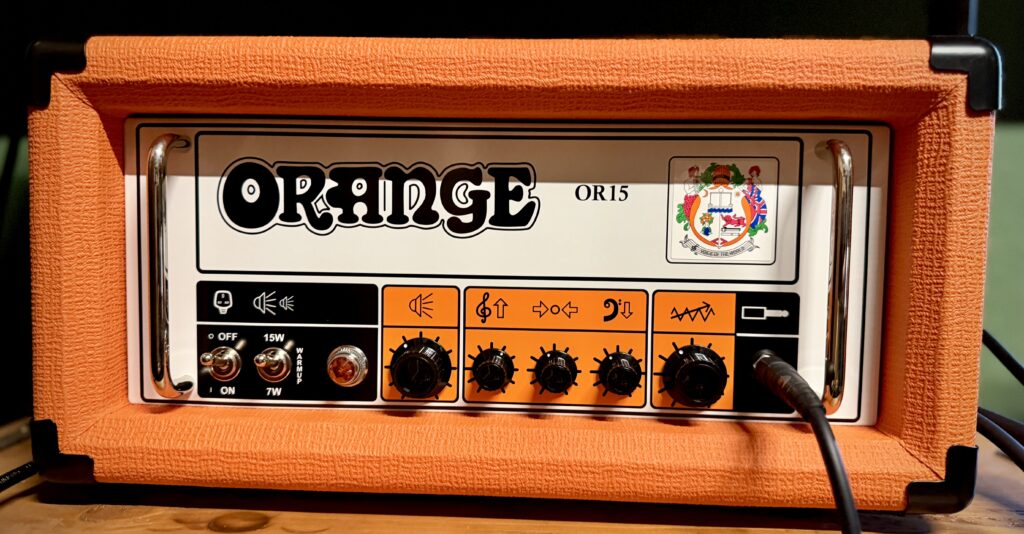
At the start of August, I bought an Orange OR15. And then I had an accident, which left me unable to play guitar for several weeks 😱
What do I think of it? Read on for my First Impressions.
tl;dr
The Orange OR15 is an amp with character.
Paired with official Celestion V30 impulse responses, it’s got some lovely lower-gain rhythm tones:
and the amp can get plenty aggressive without having to crank the gain up:
If (like me) you prefer to play in the middle position on your Les Paul (or equivalent), then it’s a good idea to stick a pedal in front of the amp to help shape the tone a bit:
Read on for more details about those tones and my opinion of this amp.
What Did You Buy?
I bought an Orange OR15 amplifier head.
- “Orange” is the brand name.
- “OR15” is the model name.
- “head” indicates that this is just the amplifier on its own (ie, it isn’t a combo amp).
The Orange OR15 is advertised as a modern take on the classic Orange sound from the 1970s.
It’s a single channel amp, with a three-band EQ (bass, middle and treble). It also features a gain control and a volume control.
It’s an all-valve amp, using three 12AX7 valves in the preamp, a single 12AT7 for the fx loop, and two EL84 valves for the power amp. (This might well be my first amp with a dedicated valve for the fx loop!)
There’s a switch on the front panel to toggle between 7 watts or 15 watts output.
I bought mine brand new from my local Orange dealer, astrings.co.uk.
Why Did You Buy It?
At the moment, I’d rather not buy brand new Fender gear. So I’ve taken that money and spent it on other brands instead. This amp is the last of those purchases.
And I just figured that this is my opportunity to start exploring what Orange amps can do.
I picked the OR15 partly because it’s what they had in the store – always an important factor when buying in person! – and partly because I really enjoyed the lower gain crunch tones that I managed to dial in.
In the store, I found it extremely easy to dial in a tone that interested me. Even with a mild crunch tone, the guitar I was using just sang. It’s the kind of experience where the amp just sells itself.
I’m also intrigued by this particular amp.
It isn’t new – it appears to have been released in 2012, when affordable low-wattage valve amps were incredibly uncommon – but somehow it’s completely flown under the radar. I’ve been shopping for affordable valve amp heads for home use since 2017, and I had no idea that this amp existed until very recently.
My Rig Today
My Signal Chain
Today, I’m playing:
- several different guitars
- into my Axe-FX 3 (for the tuner)
- out to my pedalboard
- into the front of the Orange OR15
- speaker out of the Orange OR15 into my Fryette PS-100 attenuator
- line out of the PS-100 back into my Axe-FX3 (for virtual cab, delay and reverb)
- into my audio interface
- and into my DAW.
My Choice Of Guitars
I’ve picked four guitars for this blog post:
- Jody, my all-stock Fender Vintera II Road Worn white guard Telecaster;
- Desiré, my all-stock Gibson Les Paul Junior DC;
- Deadnote, my all-stock 1st-gen PRS McCarty 594;
- and Smokey, my Gibson Les Paul Classic Plus.
That gives me single coils, a bridge P90, something with vintage-voiced humbuckers, and something with hotter humbuckers.
On The Pedalboard
I’ve got two pedals on my pedalboard today: my Klon KTR and the MXR Duke of Tone.
They’re in separate loops of my Gigrig G2. When I’m not using a pedal, it’s completely out of the signal chain so that it cannot colour the tone in any way.
My Axe-FX 3 Preset
On the Axe-FX 3, I’m running a new preset that I originally built – and then discarded – for my upcoming Marshall Origin 20H long-term review.
The preset that I was going to use with my Marshall Origin 20H features IRs that were shot using a single SM57 mic. That mic setup seems to be an important part of the Recorded Marshall Sound™ .
Unfortunately, when I tried it with the Orange OR15, I didn’t like the results. The mid-range was over-emphasised, and the rich low-end of the Orange amp almost completely disappeared.
So instead, I’m using a preset that features IRs with both SM57 and Royer R121 mics (just like I do when recording my Tweed Deluxe amp or most pedals). I think this suits the OR15 a lot more.
And afterwards, I need to go back to my Marshall Origin 20H prep work, and see if this preset is the way to go there too.
No Post-Processing, Only Level Matching
All the delay and reverb that you hear in the audio clips is coming from my Axe-FX 3 preset. I haven’t added anything in post, and I haven’t applied any EQ or compression in post either.
I will have level-matched the recordings before publishing them.
How Does The OR15 Sound?
Celestion V30s Are King
I’ve tried the OR15 through quite a few of my Celestion IRs, and I think it sounds very good through them all. There wasn’t a bad sound to be had. Can’t say that about every amp I’ve ever tried!
But I think it sounds truly excellent through a Celestion V30 (closely followed by running it through a pair of Celestion V30 and Celestion G-12M25 IRs).
That isn’t a surprise. Orange make some of the best-sounding speaker cabs I’ve ever tried, and (as far as I know) they put Celestion V30s in all of them. If you’re looking for a real speaker cab at home (or need to pick a speaker cab in a shop to test an amp head), I happily recommend you give one of the Orange cabs a try.
15W Mode: Telecaster
To start with, I have all the EQ controls on the OR15 set to 1 o’clock, and the gain up at 11 o’clock. The amp is in 15W mode.
Here’s how that sounds with the bridge pickup of my Telecaster:
While recording, that sounded like a very full sound in the room. Almost too full for my style of music.
Listening back to the uploaded audio, I’m hearing something very prominent in the low-mids. There was a time (not that long ago!) when that was the kind of thing that I actively sought out. Today, I think it’s a little too much, especially for this low-output Telecaster bridge pickup.
If I drop the Bass control on the OR15 down to 11 o’clock, it cleans up some of that low-end congestion without me needing to add a low cut anywhere else in the signal chain:
I think that’s a lot better. It sounded fuller while recording, but listening back, I’m very okay with how this now sounds.
15W Mode: P90 Bridge Pickup
Let’s repeat the same amp settings, just with a different guitar and pickup.
I’ve grabbed Desiré, my Les Paul Junior. It has a single P90 bridge pickup. It’s going to be brighter and hotter than my Telecaster was.
I’ll start with all the amp EQ controls back at 1 o’clock. Gain is still at 11 o’clock.
There’s a bit of bite and aggression to that tone. Very nice!
I’m not sure we need to drop the bass down on the amp, but let’s do it anyway and hear how that sounds.
To my ears, reducing the bass on the amp to 11 o’clock has brought more emphasis to the note attack. I don’t think it’s actively changed the note attack; more that there’s less distraction to the ear.
I prefer the clarity of my Telecaster through this amp, but the P90 might be an interesting choice for angrier tones.
15W Mode: PAF-Like Humbuckers
I really want to hear this amp with Deadnote, my PRS McCarty 594. I prefer to use this guitar in the middle position, with both pickups at the same time. That can be a challenge for some signal chains.
Let’s start with the amp’s bass control back up at 1 o’clock:
I love the softness in the attack there. There’s a growl in there somewhere, trying to get out.
Unfortunately, that thick low-end is overpowering the guitar tone somewhat. Let’s see if I can clean it up by dropping the amp’s bass control to 11 o’clock.
That’s a lot closer to my taste. Cleaning up that low-end has really brought out that lovely thick mid-range growl that I was after.
This is where I would normally reach for my Klon KTR (or a klone) to try and clean up the low-end a little more plus add in a bit of vintage character:
In this case, I’m not entirely sure that this amp needs it.
The Orange OR15 already has a bit of vintage character to it; I had to drop the Mids EQ on the amp to stop it sounding too honky in the room.
I’m also not sold on how the Klon KTR’s Treble boost is interacting with the OR15, not with my stock Klon KTR settings, anyway. The OR15 seems to get a lot of its aggression from the input signal’s treble frequencies, and I’m not running the amp hot enough to really compress those frequencies.
That’s not a bad thing. It just means this amp behaves differently to what I’d normally play through. “Differently” gives me new things to explore. “Differently” gives me new options.
I’m sure I’ll adapt my approach in time.
7W Mode vs 15W Mode: Telecaster
How do the OR15’s two output power modes compare? To find out, I’ve tried both modes with my Telecaster’s bridge pickup.
First, with all EQ at 1 o’clock:
And then, with the Bass EQ turned down to 11 o’clock:
During the recordings, the 7W mode sounded like it was starting to compress the top-end frequencies. It also felt more compressed under the fingers to play.
Listening back, I’m not hearing anywhere near as much compression as I expected. The top-end is still very jangly at 7W. There’s a slight increase in gain and a little more low-end at 7W, I reckon. But I’m not sure that I could guess which was which in a blind test unless I had fresh ears.
This particular Telecaster has got a very low-output bridge pickup, so it’s possible that I’m just not hitting the front of the amp hard enough for any compression in the 7W mode to show up.
The OR15 Works Great With Boost Pedals
Another way to use this amp is to do the classic thing of hitting the front end hard with a boost pedal.
For this, I’ve grabbed Smokey. It’s a Les Paul Classic Plus with a set of OX4 Hot Duane humbuckers. This guitar has the highest output pickups that I currently have.
I’m using the MXR Duke of Tone for this in its clean boost mode. Volume and Drive are up around 2 o’clock, while Tone is around 12 o’clock. On the amp, I’ve turned the Gain down towards 10 o’clock; partly to compensate for the hotter pickups, and partly so that the boost pedal doesn’t push the amp too far for my taste.
Here’s the Orange OR15 first without, and then with the boost pedal:
The Duke of Tone (like the original King of Tone) has quite a savage low-end cut. I often struggle with that, when I’m trying to use either pedal into a clean amp.
But here – boosting an amp that’s already dirty – the pedal’s low-end cut really works, I think.
Is boosting a “better” sound than just rely on the amp’s own gain? Here’s both of my humbucker guitars together, so that you can decide for yourself.
This isn’t a straight apples-to-apples comparison, as I’m comparing two different guitars, and I’ve made no attempt to try and match the tones at all.
What do you think? Let me know in the comments below.
Other Discussion Points
I Haven’t Explored Higher-Gain Settings
I don’t run this amp’s Gain any higher 11 o’clock. That gives me the kind of low-gain rhythm crunch tone that I call home.
This amp can get a lot filthier than this. If you want to know more about that, I’m not a high-gain player. You’ll want to head on over to YouTube and look for reviews and demos on there.
I Wish There Was A Presence Control
There’s times that I think the amp is a little too spiky for my taste.
With my choice of guitar and lower-gain settings, the amp doesn’t seem to be compressing the top-end very much. And the Treble EQ control can’t tame it without making the amp sound a little muffled.
I wish there was a Presence control on the amp to help with this.
I can get around it by adjusting the tone control on my guitars, but I’ve found that to be a difficult balancing act. I can’t always find a sweet spot where the top-end is tamed without it also cleaning the amp up too much.
I need to explore using different pedals in front of the amp, to see if I’ve got anything that can help.
Final Thoughts
The Orange OR15 is a keeper for me.
It gives me the crunch sound that I’ve always wanted from a Marshall amp. Turns out, I’ve been looking in the wrong place for it! So that’s going to be interesting to explore.
The OR15 also allows me to explore a whole bunch of pedals that are best used into a crunchy amp. That unlocks a new (to me) side of boost and drive pedals.
So far, I don’t think I’ll be using it as a pedal platform amp. The Blackstar TV-10A does that far better, in my opinion. The OR15 seems to be one of those amps you buy for the amp’s character and gain; it’s not a blank canvas.