#CoffeeAndKlon is my (irregular!) Sunday morning magazine series, where I talk about whatever’s on my mind right now. There’s always coffee, and there’s normally chat about the Klon and its many competitors.
Today, I want to talk about why I started using a Klon KTR, and demonstrate what makes it different to the other options that I had at the time. Let’s travel back in time to 2014, when the world was a (slightly) saner place and guitar YouTube wasn’t full of “they all sound the same” Klon klone demos …
Today’s Coffee
Wonky Coffee’s Guatemala Single Origin Coffee
This time, I remembered to take a photo when we emptied the coffee beans into our tin 🙂
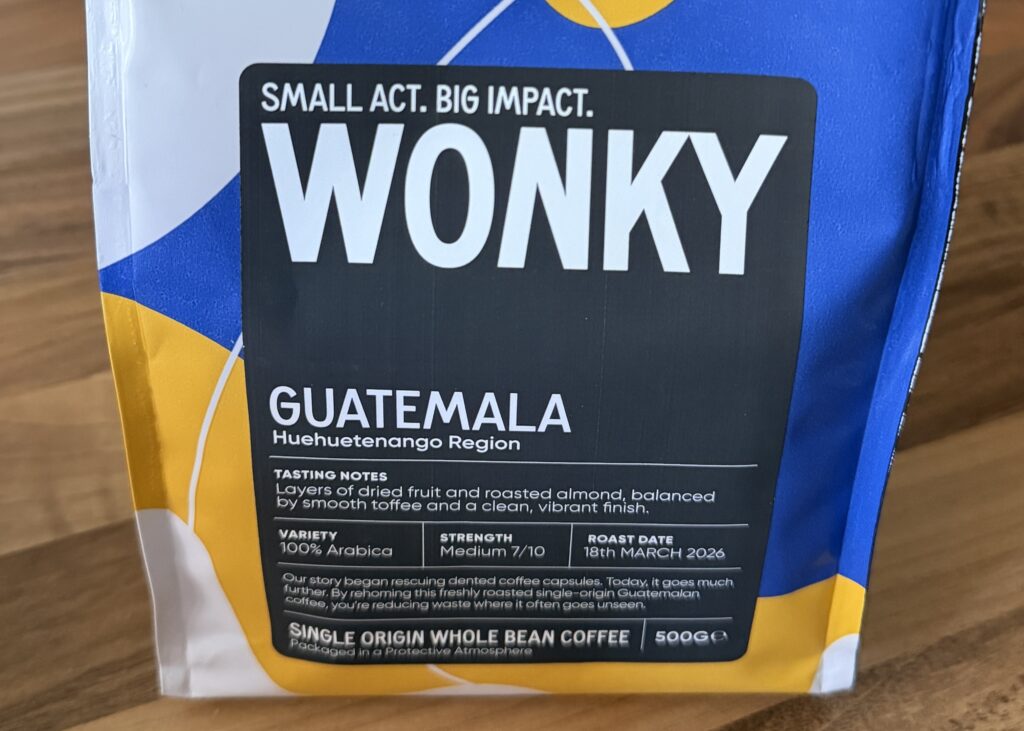
I’m drinking single-origin coffee beans, from the Huehuetenango region of Guatemala, sold by Wonky Coffee (an online retailer). Kristi and I both find this to be very drinkable.
Wonky Coffee’s business model is built around buying up previously-unsold coffee beans and selling them on to their customers and regular subscribers. As a result, they’re not selling the same product year-in, year-out.
That’s definitely the case with this Guatemala single-origin coffee. As I’m writing this, I’ve just had a glance at their online store, and this isn’t available any more.
We’ve bought most of our coffee from Wonky since the turn of the year. Partly because of how difficult it is to get coffee beans in our local supermarket these days, but also partly because of the variety that’s built into Wonky Coffee’s offerings. Every bag is different, and when it’s gone, that’s it.
And also because it’s so drinkable. I mean, I absolutely adore coffee grown in Sumatra, but I can’t tolerate a lot of it – it’s just too strong for me these days. No such issue with any of the bags of Wonky Coffee that we’ve had so far.
What Do I Want To Talk About Today?
The Clean Boost Story I Rarely Tell
I’ve written countless blog posts where I’m using my Klon KTR (or a Klone klone, such as the Ceriatone Centura) as an always-on boost into a drive pedal (such as my beloved Mad Professor Sweet Honey Overdrive).
That is the main use of my Klon KTR these days. But it’s not where I started from; it’s not why I first fell in love with this genre of pedals.
Instead, I want to talk about a side of my playing that I’ve rarely covered on here; one that (arguably) gets lost amidst all the noise (pun intended) from all the overdrive pedals that I’ve tried.
Let’s talk about using the Klon KTR as a clean boost on clean guitar playing. It’s the reason that I first fell in love with my Klon KTR, when I bought one back in 2014.
Travel Back To 2014 With Me
My dream job had turned into a toxic nightmare at the tail end of 2013, just as I’d put all of my savings into buying a new apartment. Music was my retreat from that; it was the life raft that got me through an absolutely awful year. I’d often head home at lunch time just for a few minutes on my guitar, to help me get through the day.
A lot of that time, I was starting to explore Les Pauls and vintage-voiced overdrive tones – two things that were relatively new to me. After 25 years of mostly playing thrash metal rhythm guitar, this was a complete change of … well, everything, really: a change of instrument, a change of rig, and baby steps towards finding my own voice.
But I didn’t just play thrash metal prior to this.
I was lucky enough to start playing acoustic guitar at the age of 9. While I didn’t stick at it (I didn’t enjoy the lessons), once I started playing electric guitar at 16, some of that early influence resurfaced, and most of the pieces that I wrote were for playing with clean Strat tones.
When a different job in the mid-90s turned super-toxic (ever been formally warned by an employer because a customer really liked your work?!?), that was the music I withdrew into: writing clean electric guitar pieces.
As I spent those lunch times in 2014 hiding from another toxic job, wondering how on earth I’d found myself in a similar situation yet again, I started to revisit that music once more.
The problem I had – especially through the rig I had back then – is that my clean guitar tone sounded uninspiring to me.
Crystal Clean Electric Guitar Can Be So, So Sterile
In the mid-90s, I didn’t own an amp. I was playing directly into a brand new Tascam 4-track recorder that I’d bought to ease my time working away in London. As long as I was careful, it allowed me to layer different performances together to sketch out song demos.
Today, these old 4-track recorders have become somewhat sought-after for their unique tone. Back then, hobbyists like me didn’t know anything about that. They were simply the only (barely) affordable way for solo musicians like me to record multi-part ideas.
By 2014, I was coming out the other side of a decade or so of going purely digital. I’d finally been able to afford my first real valve amp, but something was missing. As bad as digital modellers were back then, the clean channel on affordable valve amps wasn’t much better.
That was especially true if, like me, you were trying to play with a completely clean guitar tone.
Tone-Shaping Options Were Limited
Back in 2014, there was no That Pedal Show, and local guitar shops mostly carried brands such as Boss, EHX, and TC Electronics. I think Andertons (my local store at the time) were one of the few places where you could go and try anything that we’d call “boutique”.
The boutique pedal scene was firmly established, but the pedals of the time mostly fell into two categories:
- drive pedals for clean amps, or
- drive pedals to push an already dirty amp,
which (if you think about it), pretty much describes the vast majority of Boss drive pedals up to that point.
I’ve no idea if pedal stacking (running one pedal into a second) was much of a thing back then. The problem was the noise floor. Many pedals at the time didn’t just add dirt to the signal; they also added a lot of background noise. Stack two of these pedals together, and you had to chase mid-to-high gain tones just to drown out the added noise.
My (possibly wrong) memory of the time is that Mad Professor was one of the few pedal brands that explicitly marketed their pedals as being suitable for stacking together. Today, their low noise floor isn’t so unusual, but back in 2014, I found that to be a total game (gain?) changer for someone like me, who wanted to explore low-gain and clean tones.
But even Mad Professor didn’t sell anything built explicitly for tone-shaping, not as far as I knew, anyway.
Klon Has Entered The Chat
Bill Finnegan’s Klon pedals aren’t exactly designed for tone-shaping either. Well, they are but they aren’t.
According to Wikipedia (I don’t have Bill’s own words to link to, sorry), the Klon Centaur was designed to take an amp on low volume and make it sound like an amp running at high volume.
To do that, it isn’t enough for the Klon to have amp-like overdrive. It also has to mimic the way an amp circuit’s tone changes as you turn up the amp. Different amps change in different ways as the circuits start to cook, which might be why the Klon has such a powerful Tone control.
The other thing that’s relevant here is the Klon’s built-in buffer circuit. Back then, it was normal for drive pedals to have a built-in buffer. But (to my ears anyway), there’s something different about the Klon’s buffer. Play any Klon klone that doesn’t have one (or has a different buffer circuit), and that top-end sparkle and openness just isn’t there.
Whether by design, or just a happy accident due to the circuit design, component choice and component pre-screening, it turns out that the Klon stacks extremely well with other sources of dirt even if the Klon itself is being run super-clean.
Which is why I bought one.
Getting My First Klon KTR In 2014
Here in 2026, I can’t remember the last time that I saw a Klon KTR featured on someone’s pedal board over in guitar YouTube land. If I see a real Klon at all, it’ll be a Klon Centaur – but even that’s rare to see these days.
Back in 2014, though, things were a bit different. The non-pro guitar community was just becoming aware of the Klon, and the Klon KTR was both obtainable and affordable. It was featured quite a lot back then, especially by o.g. YouTube channel In The Blues.
That summer, I bought the two pedals that would become my go-to rig ever since: first my Klon KTR and then my Mad Professor Sweet Honey Overdrive. They weren’t the first pedals that I used for stacking and tone-shaping, but they were the two that stuck.
Looking back at old photos, I can see that I’d been trying to find a combination that worked for me for a good 9 months or so (possibly longer). I ended up selling nearly all of those pedals, only to buy all but one of them back in the last few years.
My Rig Today
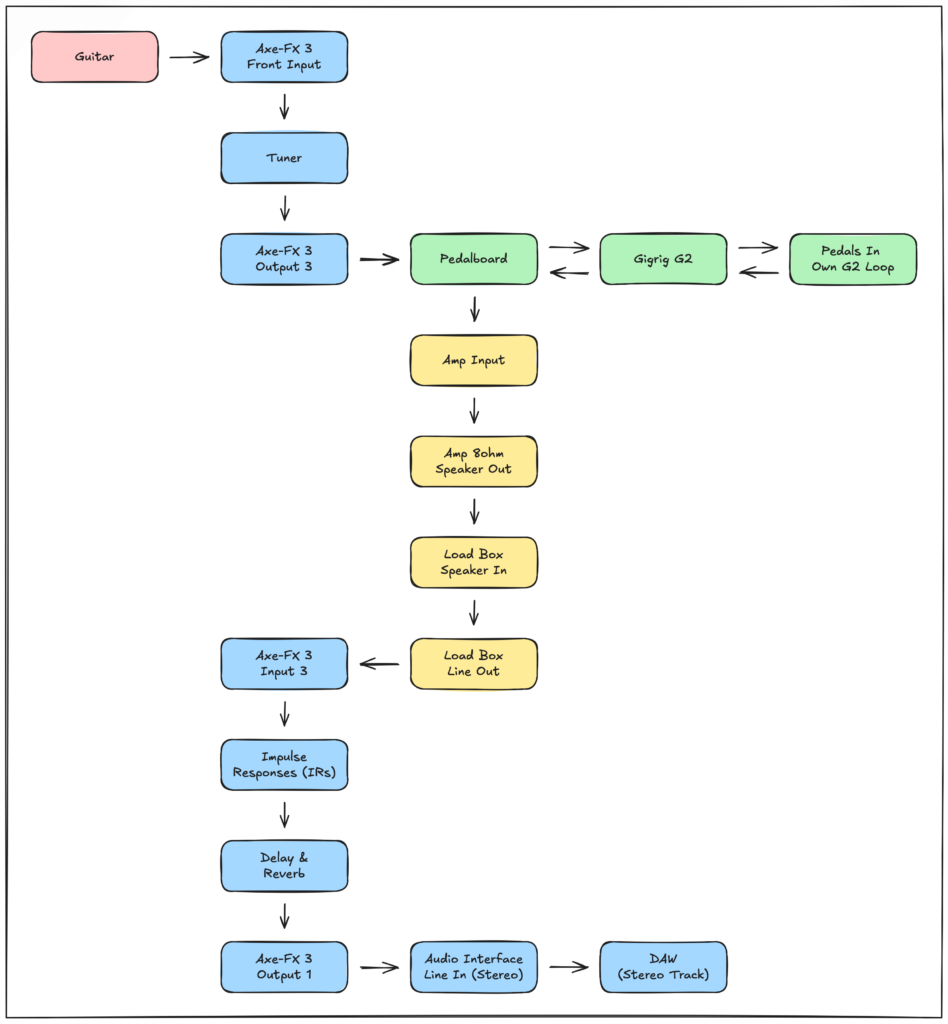
Overall Signal Chain
Today, I’m playing:
- my PRS Silver Sky
- into the Axe-FX 3 (for the tuner)
- out to my pedalboard
- into Input 2 of my 5e3 Tweed Deluxe amp
- speaker out into the Fyrette PS-100 Power Station
- line out of the Fryette back into the Axe-FX 3 (for virtual cab, delay and reverb)
- out to my audio interface
- and into my DAW.
Here’s a image showing the signal path:
My Choice Of Guitar
Back in 2014, I would have been playing my beloved 80’s Charvel.
These days, though, my “Strat”-style guitar of choice is the PRS Silver Sky. It gives me the tones I’ve always wanted – but could never find – in a Fender Stratocaster.
My Choice Of Pedals
On my pedalboard, I have my Klon KTR, Mad Professor Forest Green Compressor and Paul Cochrane Timmy v2 in separate loops of my trusty Gigrig G2. When a pedal isn’t being used, it’s completely out of the signal chain, and it cannot colour the signal at all.
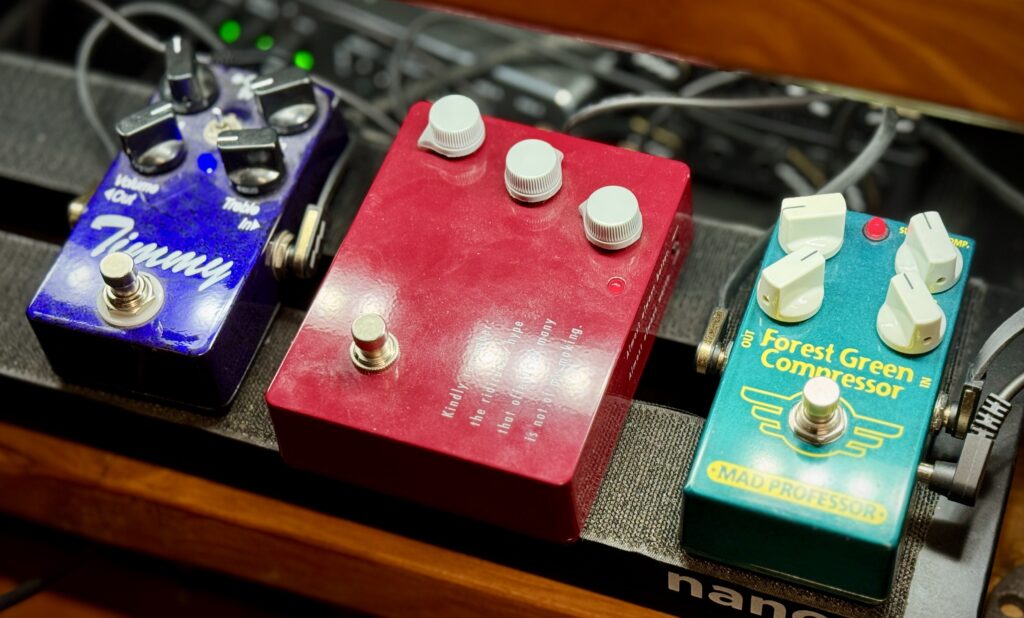
Back in 2013 and early 2014 – before I got my Klon KTR – these were the two pedals that I used to shape my guitar tone.
I think it’ll be interesting to compare all three pedals side by side, and hear what each of them does to my clean tone.
My Choice Of Amplifier
My amp from 2014 – a Blackstar HT 100 mk1 – is long gone to the recycling heap in the sky. I can’t re-create that exact original experience here.
So let’s go completely in the opposite direction, and use the best amp that I own, and see just how much my Klon KTR can really add to what a great amp can do.
My beloved Tweed Deluxe amp may be famous for its dirty tones, but it’s also got a surprisingly good clean tone hidden in there as well.
The amp settings are:
- guitar into INST 2 input
- INST volume on 5
- MIC volume on 10
- TONE on 10
Here’s a photo of my amp settings:
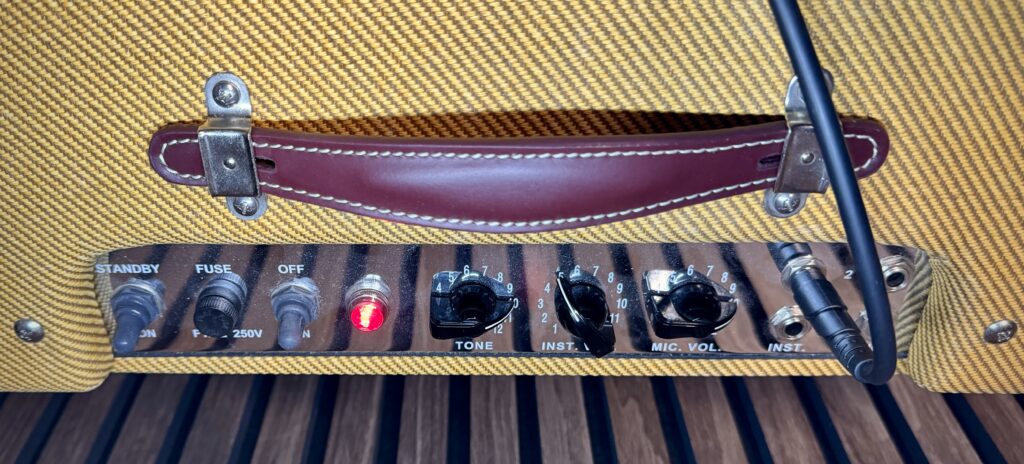
Why am I using this amp, instead of my Axe-FX 3 for this? In the past, I’ve received some criticism for writing about a Klon and its klones without using a real valve amp. So this choice is just for you (you know who you are).
My Load Box
I’m running the Fryette PS-100 Power Station purely in its passive mode; it isn’t even plugged into the mains.
The attenuator dip switches are in their middle positions, to activate the reactive part of the attenuator circuit. (When they’re in the down positions, the Power Station becomes a classic resistive attenuator instead.)
My Axe-FX 3 Preset
On the Axe-FX 3, I’m running my own HTB 5e3 Amps v3.2 fw32.05 preset. This is the latest version of a preset I started building last summer for the Origin Effects Deluxe 55 preamp pedal. I’ve got a blog post all about this preset coming out shortly.
The preset provides a virtual speaker cabinet, along with delay and reverb effects. Oh, and a noise gate too.
For speakers, I’m using official Celestion impulse responses: a mix of Celestion A-Type and Celestion Blue speakers, and Fractal Audio’s 1×12 Tweed Alnico Blue speaker impedance curve.
No Post Processing
I’m not running any plugins at all in my DAW. All the delay and reverb that you hear is coming from the Axe-FX 3.
Normally, I level-match my audio demos before uploading them. Not today. Because there’s a compressor pedal in at least one of the demos, I’ve decided instead to try and level-match the audio demos at the time of recording instead. I think this will give you a more accurate idea of what each tone-shaping pedal does into the exact same amp.
Audio Demos – Pedal By Pedal
Here Is My Clean Tone
To start with, here’s how my Tweed Deluxe amp sounds with no pedals on at all.
(If you’re listening to this and wondering why anyone would want to spoil it by adding a pedal, I can definitely understand that.)
To my ears, the amp isn’t crystal clean. When I dig in, especially on the second and third demos, the amp does get a little crunchy. I think that adds character and interest, and can be used musically to add accent and emphasis to different parts of each piece.
That round tweedy top-end though … that’s an area where I’m expecting the Klon KTR to make a difference. I do prefer more snap when playing clean. Maybe it’s because I grew up on Marshall cleans?
Let’s start throwing pedals in front of this glorious glorious amp.
The Forest Green Compressor Is An Underrated Tone-Shaping Tool
I got my first Mad Professor Forest Green Compressor in late 2013.
It was ever-present on my board all the way through until the first COVID lockdown, when I scaled back to the 3-pedal board that appears in all of my photos here on the blog. I love it so much that I actually have two of them! (More on that story a little further down …)
Although I bought it for tone-shaping, I’ve also been known to use it to slam the frontend of an amp and kick it into more overdrive. That’s something that I need to revisit here on the blog when I have the time.
I’ve kept hold of my Forest Green Compressor because I like having options. It’s one of the pedals that I’ll reach for when my Klon KTR is a bit too much. That, and sentimental value: it was one of (if not the first) Mad Professor pedals that I bought.
Here’s how it sounds, into the front of my Tweed Deluxe amp. (This is something I’ve never tried before!)
As you can hopefully hear, in its Sustain mode, it isn’t entirely transparent. To my ears, the notes have a clearer attack; they sound a little snappier. I think it’s tightening up the low-end and adding in some additional treble content. The Tone control on this pedal is quite different to a traditional Tone control!
Although I did my best to set each level to unity volume, the Forest Green Compressor is clearly driving my Tweed Deluxe amp harder whenever I dig in. I’m assuming that my ears did a lousy job at level-matching there!
Finally, you might notice that there’s no electrical noise on those three demos. I recorded all the demos at the same time; the noise is definitely there on all the other demos. I’ve no idea what’s going on there.
I Find The Timmy V2 Difficult To Love
Looking back at old photos my pedalboards, the Timmy v2 is a pedal that keeps getting pushed off of my board.
When I got my Klon KTR, that replaced my Timmy v2 on my main pedalboard. (The Timmy v2 only lasted on my main board about three months!) It got relegated to my grab-and-go board. It lived on there for about 18 months, until I replaced it with a second Forest Green Compressor at the start of 2016.
(Looking back at my old emails, I ended up buying that second Forest Green Compressor brand new from Mad Professor, after about 6 months of losing out on second-hand examples on eBay. I must have really wanted to replace the Timmy v2 at the time!)
I do bring it out every now and then for blog posts like these, but it’s never managed to force its way back onto my pedal board.
Here’s how it sounds, in front of my Tweed Deluxe amp.
More than anything else, the Timmy v2 sounds like the ultimate transparent pedal to me. It’s not that it doesn’t change the tone – it clearly has (as I’ll discuss further down). It’s more that the resulting tone somehow sounds more natural than before.
If you gave me those recordings with no context or signal chain info, I probably wouldn’t even guess that there’s a pedal in that signal chain.
Listening back, I thought that I might have set the Timmy v2’s volume too quiet. However, according to the meters in my DAW, that’s not the case. The Timmy v2 seems to be taming some of the louder transients, and thus creating the impression it’s quieter overall.
On its own like this, I struggle to love the results I get from my Timmy v2. It’ll be interesting to see if I still feel the same when we compare each demo track side-by-side further down!
12 Years On, The Klon KTR Is Still My #1 Option
Let’s move on to the pedal that kicked the Timmy v2 off my main pedal board: my beloved Klon KTR.
Here are the three demo pieces, all performed with my Klon KTR set up in the classic clean boost configuration (Gain around 8 o’clock, Treble at 1 o’clock, Volume set for unity gain at around 9 o’clock).
At this point, the Klon KTR sound is firmly “home” for me. It’s not just the tone that I’m used to, it’s the one that I regularly build my signal chains around.
I’m well past utility these days. This is firmly my comfort zone.
Audio Demos – Demo by Demo
Let’s Come At This From The Other Angle
We’ve heard the amp on its own, and each pedal in isolation.
Let’s group the different audio examples together by the demo track, and hear what each pedal does back to back.
Demo #1
First up, here’s the first demo piece that I played.
To my ears, I want to separate them out into two sub-groups:
- I think that the raw amp and the Forest Green Compressor sound similar to each other;
- and I think that the Timmy v2 and the Klon KTR also sound close to each other, but noticeably different to the other two audio tracks.
I think the Timmy v2 sounds the most different of the four. I can’t put my finger on exactly why. It’s more that it sounds a little lifeless compared to the other three options. I guarantee you that it’s entirely down to how I’ve dialled in it.
Across the four audio tracks, I’m hearing the biggest differences in the low-mids and note attack. To a greater or lesser agree, the pedals are reducing the perceived volume of the low-mids, while adding crispness to the attack of each note.
- The Klon KTR does this by tightening up the low end, adding a mid-boost, and brightening the overall tone with its integrated buffer + slight treble boost.
- The Timmy v2 does this by cutting the bass that goes into its overdrive section, which shifts the overall balance of the tone.
- The Forest Green Compressor’s tone control seems to act both as a compression mix and as a tilt EQ control.
Onto the next demo!
Demo #2
Here’s my four takes of the second demo piece.
This time around, the Forest Green Compressor stands out because of how it’s driving the amp harder than the Timmy v2 or Klon KTR.
And I think the Klon KTR stands out the most because (to my ears) it’s taking more low-end away than the Timmy v2 is. That’s the big surprise for me here. It’s the other way around in the other demos. Did I just play the low-E string a lot less during the Klon KTR performance or something? Or is there something really going on there?
Demo #3
Third and final demo. This piece combines single note nuance with more driven chord work. Let’s hear what it reveals.
I think this piece does a great job of capturing why I fell in love with the Klon KTR as a clean boost for my Strat at the time.
What I’m hearing:
- more note separation than the raw amp (not that this amp sounds bad, mind!);
- more dynamics than the Forest Green Compressor or the Timmy v2; and
- a less sterile tone than the Timmy v2.
Looking at the playback meters in my DAW, the Klon KTR is giving me about the same playing dynamics as the raw amp did. As you might expect, the Forest Green Compressor really isn’t, while the Timmy v2 sits somewhere in between.
Bonus Audio Demos – Ye Olde Blackstar Cleans
I Found An Old Blackstar Amp!
I think the Tweed Deluxe is a great amp for showing just how good a Klon KTR can sound. But I accept that I’m starting from a clean tone that’s already excellent in many ways. The changes are not dramatic; it doesn’t get across my experience back in 2014.
So I’ve dug out my old Blackstar HT-1R to see if this gets my point across more obviously
I’m running the HT-1 through my upcoming Marshall Origin signal chain; I haven’t tried to build a dedicated Axe-FX 3 preset to get the very best out of this old Blackstar amp. On top of that, the amp itself is dimed, and I’ve also had to dime the output on my loadbox in order to get a usable signal level from the amp.
If you happen to like what you’re about to hear, and want this ye olde Blackstar cleans for yourself, I recommend you try and pickup an old Blackstar HT-5 instead. The extra output will probably make it a lot easier to record the audio!
Demo #1
Let’s start by putting these two amps into their respective sonic contexts. Here’s both amps without any pedals.
To be fair to the HT-1, I am running this maxed out, and that’s the main reason it might sound a little plasticky to your ears. That’s just the amp running out of headroom. The amp doesn’t really have anywhere left to go, and neither does my attenuator.
This is about as bad as a Blackstar valve amp clean can ever get.
In contrast, my Tweed Deluxe isn’t even breaking a sweat. It also has several more valves to add harmonic richness. And the attenuator wasn’t goosed either.
So please keep all that in mind. The Blackstar HT-100’s clean channel would have sounded somewhat better than this, if only because it wouldn’t have been right up against its limits.
However, this is all I’ve got, so let’s make the most of it.
Let’s hear how the Klon KTR affects this clean tone.
To my ears, that’s a big improvement. I really like the way the Klon KTR has shifted the guitar tone, placing a little more energy and emphasis in the upper mids.
Demo #2
Let’s hear the second piece through the ye olde Blackstar clean:
I’m hearing less improvement here, and I think it’s because the HT-1 has nowhere left to go.
I think it sounds less plasticky with the Klon KTR, but that might just be wishful thinking. The pick attack is still percussive, but I find it less intrusive than when just playing the raw amp.
I’m also hearing more note clarity and separation in places with the Klon KTR. There’s a couple of places with the raw amp where I didn’t get the cleanest of strums, and that comes across really clearly. I don’t know whether I simply played better through the Klon KTR, or whether it did a great job of emphasising the transients for me. Either way, I prefer it.
Demo #3
Let’s hear what my Klon KTR does in the final demo piece.
As with the earlier Tweed Deluxe demos, I think this piece does the best job of showcasing how the Klon KTR changes the original amp’s clean tone. I don’t really have much more to add to that.
What do you think? Let me know by leaving a comment below.
Final Thoughts
It’s always useful to sit down, record audio demos, and spend a good deal of time listening to them without a guitar in my hands.
What really leapt out to me was how much I prefer the sound of my Klon KTR over the results that I can get out of my Timmy v2. And it’s not like the Timmy v2 sounds bad; far from it. It’s just that my ears find the Klon KTR interesting, but they find the Timmy v2 very uninteresting.
Does the Klon KTR make my Tweed Deluxe’s clean tone sound “better”? I think it does, because it preserves dynamics while improving note clarity and note separation. Or, to put it another way, it shifts the overall EQ balance and energy to make my guitar catch my ear a little more than before.
I think the impact of the Klon KTR is more obvious when I listen to the audio tracks that use my old Blackstar HT-1. It takes a fairly sterile clean and at least makes it far more interesting to listen to and especially to play through.
I’m going to leave you with this thought:
Clean tones sure have changed over the last 70+ years! Modern clean tones are so mid-scooped, it’s no wonder that a Deluxe Reverb doesn’t sound scooped enough to me most of the time.