It’s that time of year again, where I have another go at building a signal chain to capture a reference tone for my beloved 5e3 Tweed Deluxe amp.
This time though – as the post’s title suggests – things are a bit different. Instead of one reference tone, I’ve built a couple of them. Let me explain why …
tl;dr
I’ve revisited my approach, and built two new 5e3 Tweed Deluxe reference tones for 2026:
- one using my Fender ’57 Custom Deluxe amp (their modern Tweed Deluxe reissue), and
- one using the Deluxe Tweed Bright model in my Axe-FX 3.
This will allow me to explore whether a piece of tweed-tone gear is more like a modern-day Tweed Deluxe reissue or closer to a vintage Tweed Deluxe amp. And it also gives me a fallback if I replace my Tweed Deluxe with a Lazy J amp.
Here’s how they sound. First, the real amp (with and without my Klon KTR):
… and now the Axe-FX 3 Deluxe Tweed model (with and without my Klon KTR):
What to hear this signal chain with a PRS Silver Sky, or a Gibson Les Paul with P90s, or a different Gibson Les Paul with regular humbuckers? You’ll find those audio demos further down.
What Are You Trying To Do?
I am trying to record the sound of my 5e3 Tweed Deluxe amplifier.
I want the result to be to be suitable as a reference tone – something that I can compare other gear against.
But more than that, I don’t want to have to keep revisiting this. I want to land on an approach and signal chain that’s going to last more than a few months this time.
Why Do You Want A 5e3 Reference Tone?
I write about guitar overdrive pedals on this blog a lot. Especially about pedals that claim to chase the sound of vintage tweed-era amps like the 5e3 Tweed Deluxe.
Many of these pedals sound and feel amazing. But are they actually a viable substitute for the sound of a real 5e3 Tweed Deluxe amp? Can they be setup to get the type of sounds that I dial up in my amp?
I want a way to put that to the test, and evidence that I can share with my readers to back up any conclusions that I come to.
Haven’t We Been Here Before?
The Problem I Keep Coming Back To
Regular readers may recall that this is not my first attempt at this:
- my first attempt was back in 2022,
- I made another attempt in 2023,
- and I made a third attempt only last year.
(There’s probably other attempts too that I’ve forgotten about. Feel free to call them out in the comments below.)
Why Do You Keep Revisiting This?
My previous attempts just didn’t stick. I’d use them for a bit, fall out of love with them, and revert back to using tweed-tone pedals instead.
I have plenty of good reasons to believe that this attempt will be different.
What’s Different This Time Around?
I’ve Been Using Real Amps Regularly
Back in August 2025, I went back to using real amps (instead of the Axe-FX 3) most of the time. (I’m still using the Axe-FX 3 at the heart of my hybrid rig.)
It all started when I bought an Origin Effects Deluxe55 amp-in-a-box pedal. I started off by running that through my previous attempt at a Tweed Deluxe signal chain, and just wasn’t happy with the results.
To get the best out of the Deluxe55, I needed to start again. I ended up rebuilding my Tweed Deluxe signal chain, validating it against the Deluxe55, the Axe-FX 3’s Deluxe Tweed amp model and my Tweed Deluxe amp.
Then, sometime in late 2025, I started work on a new signal chain for my Marshall Origin 20H, Marshall DSL20HR, Synergy, and Blackstar Debut 100RH amps. With so many amps to support, that turned into quite the journey. Expect a couple of blog posts about that very soon!
Some of what I learned from working with my Marshall heads also fed back into the Tweed Deluxe preset. I think my Tweed Deluxe preset is better for it.
All told, I’ve been working on this latest Tweed Deluxe preset for a good 11 months now.
Benefiting From A Slower Pace And More Listening Sessions
There’s a lot to be said for living with the same signal chain for weeks (if not months) at a time.
A full-time professional can probably build a great signal chain in a single session, especially if they’re a seasoned studio engineer. They know what they need from the final tone, and they know exactly what adjustments they need to make (and where to make them) to achieve that outcome.
Someone like me, a home hobbyist? Not a chance.
Thankfully, because I’m just a home hobbyist, I have the luxury of time. I can take as long as I need to explore this guitar tone and signal chain. There’s no pressure of studio bookings, and no need to pump out content to keep social media algorithms fed.
I’ve learned the importance of walking away from a signal chain, and coming back the next day with fresh ears. And then coming back again and again and again, long after I’ve stopped tweaking the signal chain.
It’s a much slower approach to what I’ve done before, which can be frustrating in the moment. I think it’s worth the trade-off, though.
The Axe-FX 3 Has Evolved A Lot Recently
Over the last 12 months or so, I’ve experienced a big change in the Axe-FX 3. New firmware releases have delivered a lot of sonic improvements to all the amp models and the digital FX that the Axe-FX 3 delivers, and I think they’ve really added up.
I’ve been able to strip out pretty much all of the EQ-related tweaks that I’ve previously felt were essential when building presets for the Axe-FX 3.
At the time of writing, I feel that I’m reaching for EQ mostly for taste / personal preference. The remaining EQ’ing is just low cuts / high pass filters, to solve problems from analogue gear and IRs. It feels like the kind of EQ’ing that studios did back in the all-analogue days.
(The Tweed Deluxe preset uses the Axe-FX 3’s Tube Pre amp model, because it’s the only way that I can apply speaker impedance curve emulation.)
There have been improvements to the Tweed Deluxe models in the Axe-FX 3 too along the way. These models should now be a lot more faithful to Fractal Audio’s reference amp.
Oh, and in the last couple of weeks, Fractal Audio have just added an amp model (the Deluxe Tweed Normal) that models plugging into the MIC channel of a Tweed Deluxe amp. I’m not using it here (because I don’t use that channel on my real amp yet), but it’s good to know that it’s available if I find a use for it.
I’ve Got Better Tools To Test The Tone With
Last September, I picked up one of the limited-run Road-worn Telecasters. It’s a fantastic tool for dialling in tones, because it sounds so distinctive in each pickup selector position. In particular, it’s really good at revealing signal chains where too much low-end is accumulating.
I’ve also discovered how to setup Deadnote – my PRS McCarty 594 – to get a much brighter sound when playing in the middle position. That really helps me avoid over-compensating the tone settings when I’m adjusting any 5e3 amp, model, or amp-in-a-box pedal.
Along with my 52 Reissue Telecaster (I already wrote about its importance last time), I feel that I can do a much better job of dialling in more accurate tones now.
I’ve Learned From Played My Tweed Deluxe Amp A Lot More
Earlier this year, I bought a KAT Load*Star attenuator, so that I could play my Tweed Deluxe amp at home volumes. I’ve been playing quite a lot since.
While an amp-in-the-room tone isn’t the same as a recorded guitar tone, it has helped me understand that I’ve been dialling in far too much low-end in my recorded tones.
We can trace that to my 1×12 cabs being sat on the floor. I used them that way for years, and simply got used to the EQ imbalance that that causes. It was just the normal sound for me.
Now I know a little better. Hopefully, that will translate into the tones I’m now dialling in?
I’ve Played More 5e3 Tweed Deluxe Amps
In previous years, the only experience I had to go on was with my Tweed Deluxe amp, and video demos up on YouTube.
I have recently played a couple of other 5e3 Tweed Deluxe amps: another Fender ’57 Custom Deluxe, and a Lazy J 10LC 😍🤤
That’s helped me test my understanding of how to dial in a Tweed Deluxe amp, and given me more confidence that the settings I use with my own amp aren’t outlandish or outliers in any way.
I feel a lot more confident now in being able to say: “this is the sound that I expect from anything claiming to do the 5e3 thing; this is how I’d dial that sound in on a real amp; and this is why your 5e3-chasing product isn’t as complete as your marketing states.”
I still need to play a lot more Tweed Deluxe amp examples, though, to continue that education. If anyone in the UK wants to offer me some time on a vintage Tweed Deluxe amp, yes please 😁
I’ve Validated The Speaker Cab IRs With My Pedal Platform Preset
I’ve taken my existing HTB 15 Vintage Axe-FX 3 preset – the one that’s specifically voiced for exploring tweed-tone pedals – and dropped in the IRs from this Tweed Deluxe reference tone preset.
That worked just fine. No need to tweak anything in the IRs at all.
I’ve Validated The Entire Signal Chain Using A Second Amp
I recently picked up a Blackstar TV-10A 10W 6L6 amp head. It’s their latest blackface-voiced pedal platform amp; an evolution of their excellent Studio 10 6L6 combo from 2019.
I’ve run the TV-10A through this signal chain – simply swapped out my Tweed Deluxe and wired the TV-10A in its place – and it just worked.
While I do need to spend months with the TV-10A, the initial results were incredibly encouraging. Ran a tweed-tone pedal into the TV-10A, and I was very happy with what I heard.
(I may have spent several days simply enjoying the new amp when I should have been finishing off this blog post 😁)
Why Do I Need Two Reference Tones?
The Penny Has Finally Dropped: Other Gear Isn’t Chasing The Sound Of My Amp
Whether it’s the Axe-FX 3, the UAFX Woodrow, the UAD Fender 55, or the Original Effects Deluxe55: they’re all chasing the sound of vintage Tweed Deluxe amps made in the 1950s. (I assume many pedals are too, especially if they’ve been designed in the USA.)
And most of those (maybe all of them?) are also chasing the sound of a vintage Tweed Deluxe amp running at 110 or 120 volts – not the 240 volts we have over here.
As much as I love it, I believe that there are real differences between my Fender ’57 Custom Deluxe and anything that’s recreating a 1955-era Tweed Deluxe amp:
- my Tweed Deluxe amp breaks up earlier,
- it has more saturated drive,
- it can get higher gain tones before note definition starts to collapse,
- it doesn’t produce many (if any) ghost notes when playing lower notes.
And those are just the differences that I’m aware of. I’m sure there’s more to be discovered.
It’s taken me years for the implication to sink in. (What can I say? I’m a very slow learner!)
My Fender ’57 Custom Deluxe cannot be my only reference tone.
I think it’s still a useful reference, but when (pretty much) everything else out there is chasing a different sound, it’d be great to have a reference for that sound too if I can.
That will help me say whether or not a piece of gear is leaning more towards that vintage-era sound.
I’m Not Sure If I’m Keeping My Fender ’57 Custom Deluxe
Don’t worry. I’m not in any danger of falling out of love with the Tweed Deluxe sound any time soon. But I might be trading in my current amp for something even better.
When I first bought my Fender ’57 Custom Deluxe, one of my friends (hi Matt!) said he was surprised that I didn’t get a Lazy J amp instead. Well, last autumn, I finally got the chance to play a Lazy J 10LC … and now I want one to be my forever Tweed Deluxe amp.
(Should I get the Lazy J 10LC or the Lazy J 20? If you’ve played them both, let me know your choice in the comments below!)
If I get the Lazy J, I’m not sure that I’ll be keeping the ’57 Custom Deluxe as well.
- I don’t really have space for both a Lazy J and my ’57 Custom Deluxe. (Combo amps just don’t stack the way that amp heads do.)
- If I’m going to make space for two combo amps, I want the other amp to be a Tweed Bassman of some kind. (My local guitar store just got one in too, but I’m not pulling the trigger on anything brand new from Fender for the moment.)
- I probably need to sell the ’57 Custom Deluxe to fund the purchase of the Lazy J.
And also … how often I am I likely to use the ’57 Custom Deluxe if I get a Lazy J amp? It’s going to be the Lazy J all day long – otherwise, what’s the point of buying one, right?
I have no idea when I’ll get one (or even if). If I do, I don’t know if a Lazy J 10LC is a reasonable amp to use as a Tweed Deluxe reference tone. (I suspect not.)
So, to be on the safe side, I reckon I need a second reference tone that I’ll still have if I do trade up from the ’57 Custom Deluxe.
Climate Change Limits When I Can Use My Real Amps
I live in the UK, where houses were built to keep heat in, and where we don’t have domestic air conditioning. When we have spells of hot weather, it gets a bit toasty indoors, and it takes several days of cool weather for the solid stone walls to stop being heat radiators.
And we’ve been having an increasing amount of hot weather.
My Tweed Deluxe isn’t happy in the heat, and I don’t want it heating up an already-hot room either. So when it’s hot, I prefer to stick to my Axe-FX 3 instead.
The Axe-FX 3 has active cooling. The tone from the Axe-FX 3 doesn’t change as the unit warms up. It’s consistent and reliable. And it doesn’t pump out anywhere near as much heat as my real Tweed Deluxe amp does.
Key Decisions That Shaped The Signal Chain
One Axe-FX 3 Preset For Both Amp And Amp Model
Right from the start, I knew that I needed a single Axe-FX 3 preset that worked with external amps (my Tweed Deluxe, the Origin Effects Deluxe55) and with the Axe-FX 3’s Deluxe Tweed amp models too.
Part of it is that I wanted to eliminate as many accidental differences as possible. While Axe-Edit is amazing in many ways, it doesn’t really include features for keeping presets consistent with each other over time. It’s a lot easier to keep things consistent if said things are all in the exact same preset.
But the real driver is this: when I use my Tweed Deluxe amp, I’m not just listening to the amp on its own. What I’m actually listening to is the sound of my amp into a loadbox. Loadboxes always colour the sound, because their reactive load has a baked-in speaker impedance curve.
I did some A/B experiments, and found that I prefer the Deluxe Tweed amp model if I configure it as-if it’s also an amp running into a loadbox.
Let me show you what I mean.
Here’s a screenshot of Scene 1 in my preset. This is what I used with my real Tweed Deluxe amp:
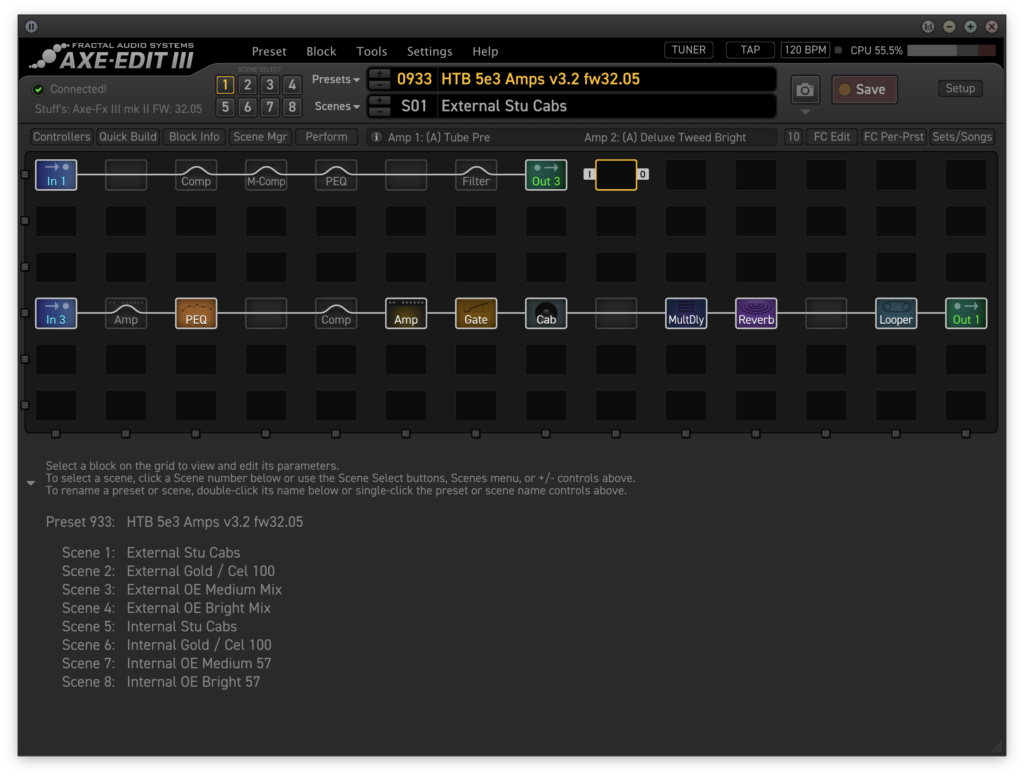
If you’re familiar with Axe-Edit, you’ll see that there’s an Amp block active in the signal chain. That’s running the Tube Pre amp model, so that I can apply speaker impedance curve emulation to the signal coming from my real amp and loadbox.
And here’s a second screenshot, showing Scene 5. This scene uses the Axe-FX 3’s Deluxe Tweed Bright amp model:
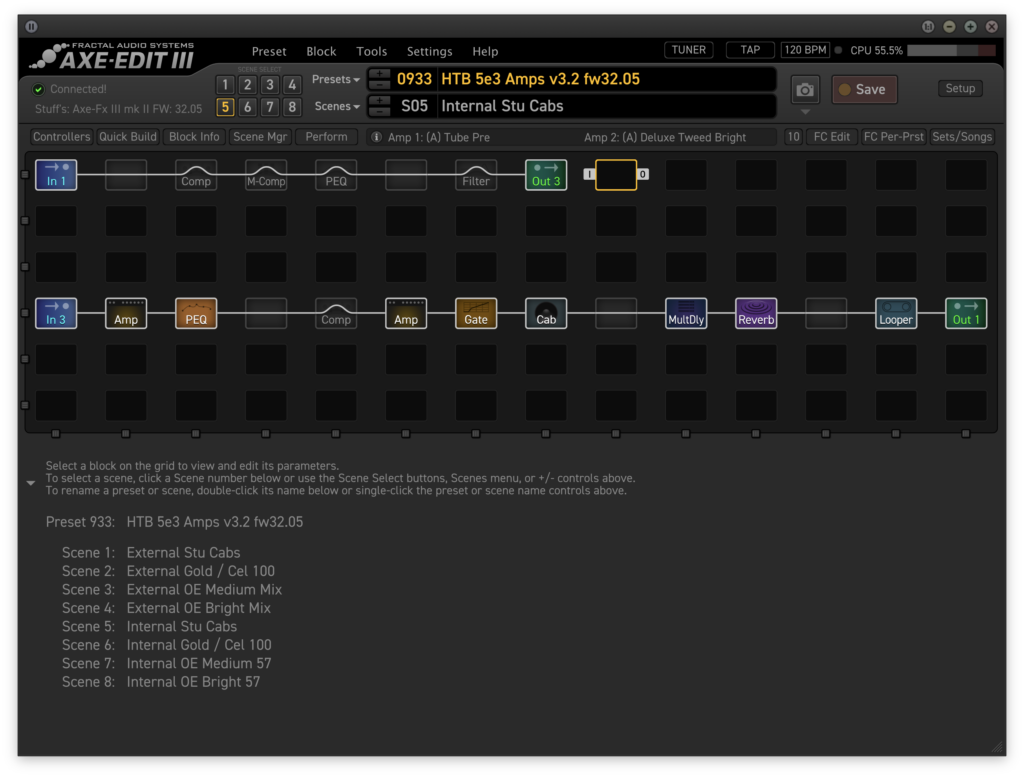
The only difference between Scene 1 and Scene 5 is whether or not the Amp block (circled below) is active (Scene 5) or bypassed (Scene 1).
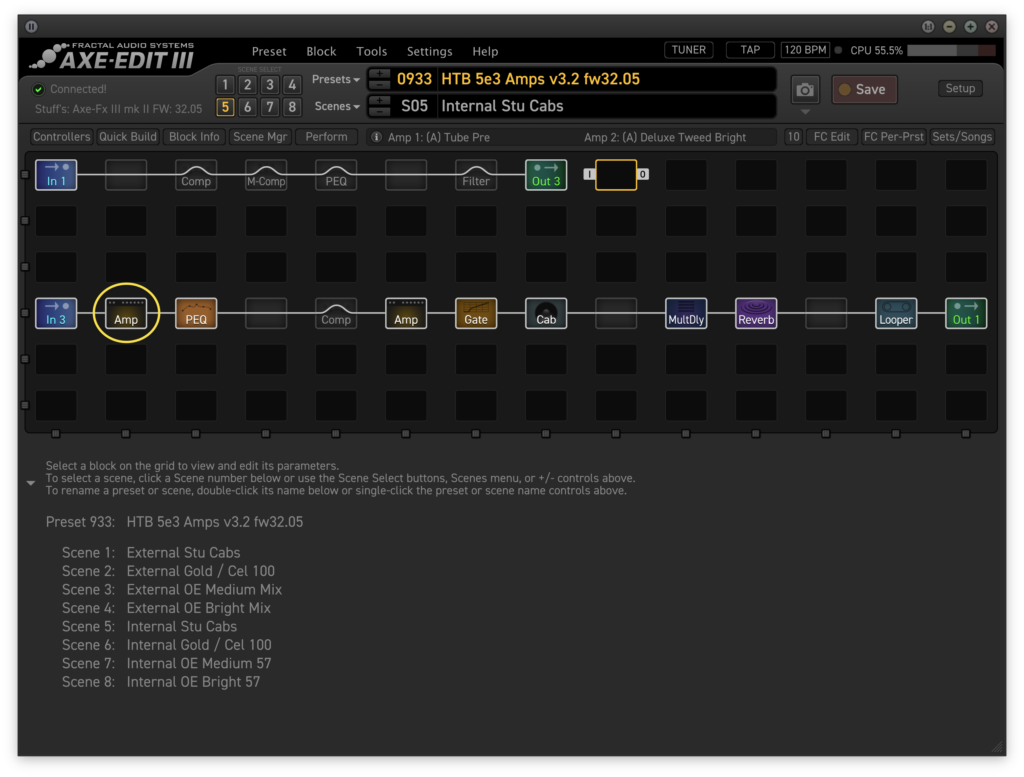
The loadbox emulation magic is happening inside the highlighted Amp block.
The Axe-FX 3 doesn’t have speaker impedance curves for the Fryette Power Station (alas). So I’ve gone with the next best thing. I’ve taken the speaker impedance curve for Fractal’s own loadbox, and adjusted it by ear for taste.
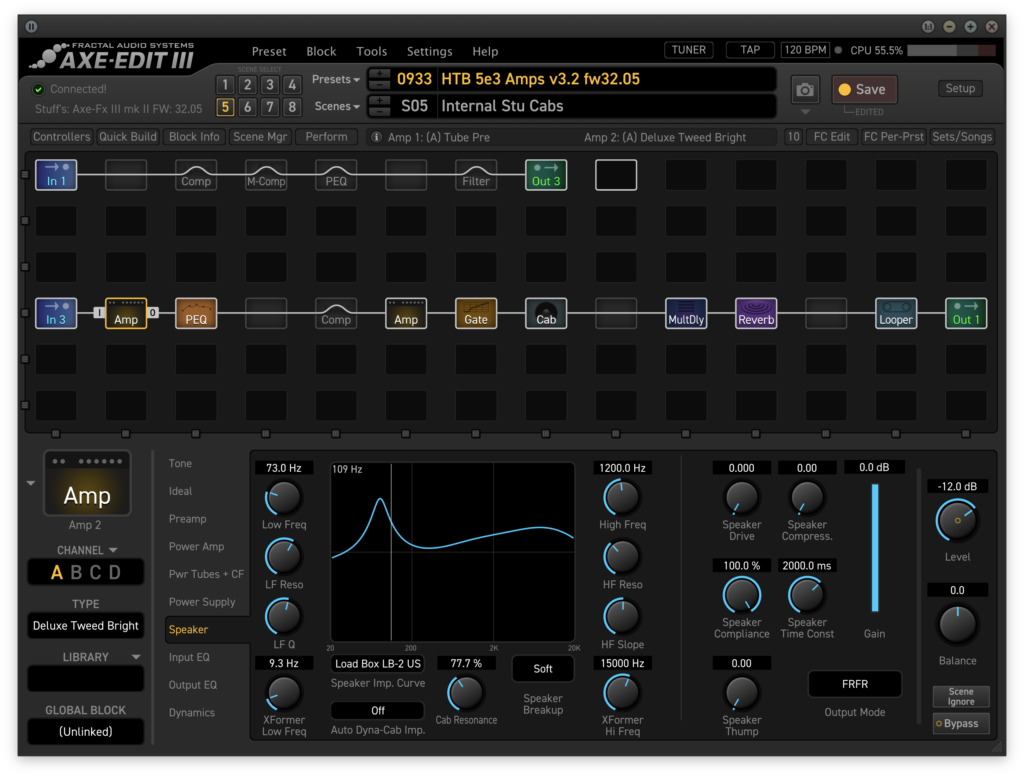
To my ear, this makes the Deluxe Tweed amp model land in the same ballpark as my real amp and real loadbox. It still has all those differences from my real amp that I mentioned above – none of that has been lost. This technique just makes the two signal chains sound comparable, rather than sounding completely unrelated.
I’ve further verified this approach by swapping out my real amp and loadbox for the Origin Effects Deluxe55, and then comparing that to the Deluxe Tweed amp model w/ emulated loadbox.
Going Back To My Celestion Speaker Blend As First Choice
Last time I built a Tweed Deluxe reference tone, I wrote a lot about how good the Origin Effects’ Tweed Deluxe impulse responses are. My opinion there hasn’t changed. For a vintage-authentic sound, I think they’re an excellent choice.
I’ve just come to realise that it’s not the sound for me. And I think they’re a little too mix-ready for my comparison audio demos.
So I’m sticking with the sound that I’ve been using since 2018: a mix of Celestion A-Type and Celestion Blue speakers.
- Celestion Blue speakers are a popular choice for 5e3 Tweed Deluxe amps (Fender have used them in the past, and they’re currently the stock speakers found in Lazy J 10LCs and Lazy J 20s, for example).
- To my ears, the Celestion A-Type fills in some of the mid-range detail and moderates some of the top-end harshness of a Celestion Blue.
I’ve been very happy with this speaker pairing in my pedal-platform amp rig for the last few years. I know that they’re a great choice for showing how good many tweed-tone pedals can be.
I’m using the official Celestion impulse responses, taken from 1×12 open-backed cabs, that I bought towards the start of 2018. Here’s a screenshot showing how I’m using them:
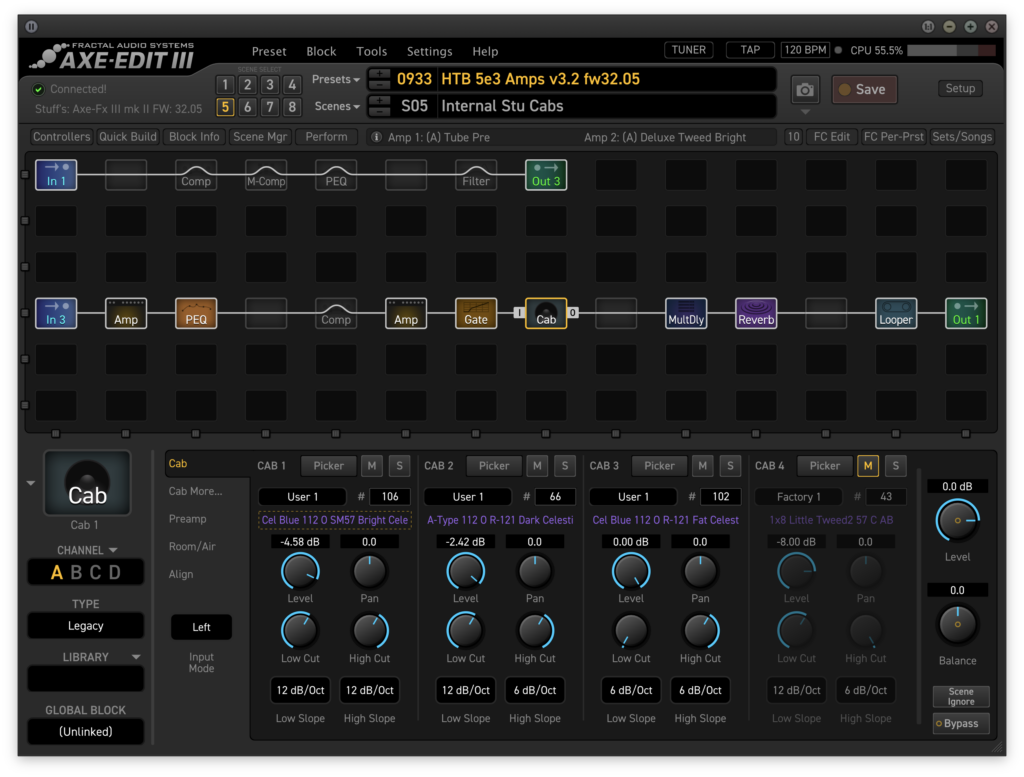
IR slot 1:
- IR: Celestion Blue SM57 Bright
- Level: -4.58 dB
- Low cut: 80 Hz, low slope of 12 dB per octave
- High cut: 8000 Hz, high slope of 12 dB per octage
IR slot 2:
- IR: Celestion A-Type 121 Dark
- Level: -2.42 dB
- Low cut: 80 Hz, low slope of 12 dB per octave
- High cut: 8000 Hz, high slope of 12 dB per octave
IR slot 3:
- IR: Celestion Blue 121 Fat
- Level: 0 dB
- Low cut: 20 Hz (the minimum value), low slope of 6 dB per octave
- High cut: 8000 Hz, high slope of 6 dbB per octave
All the speakers are panned straight down the middle; none of them are panned left or right at all.
Here’s a screenshot of how they are phase-aligned:
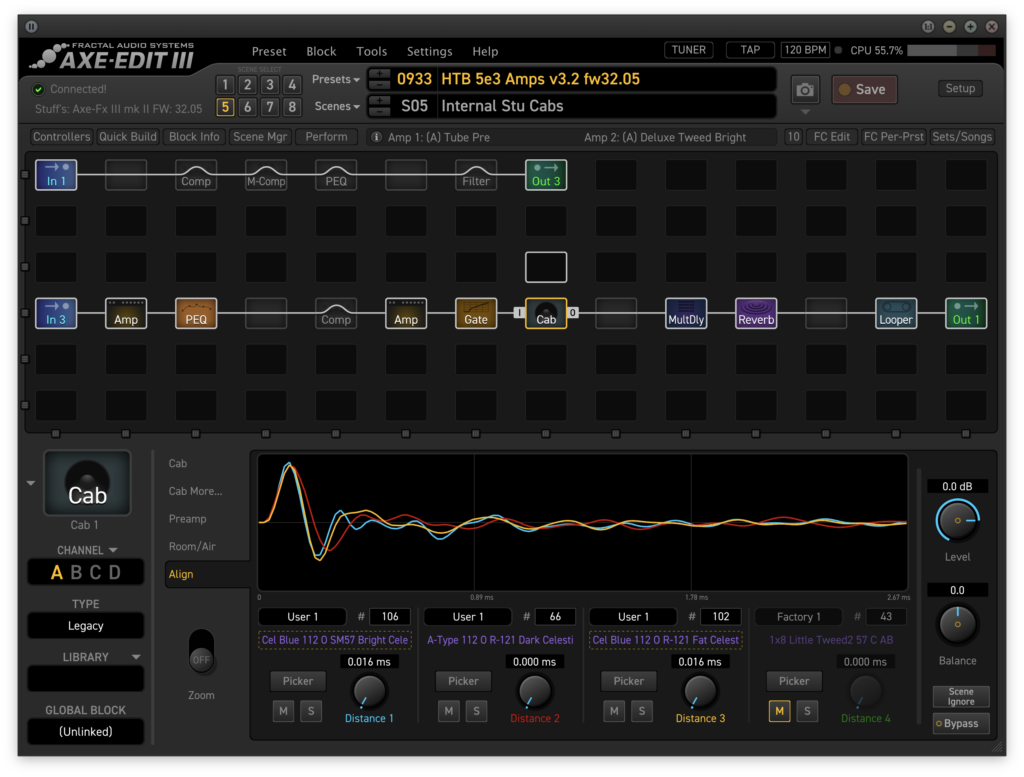
Hopefully you can see that I’ve chosen to align them as close to their initial peak as possible.
To support my speaker choice, I’m running a Tube Pre amp model so that I can set the following speaker impedance curve:
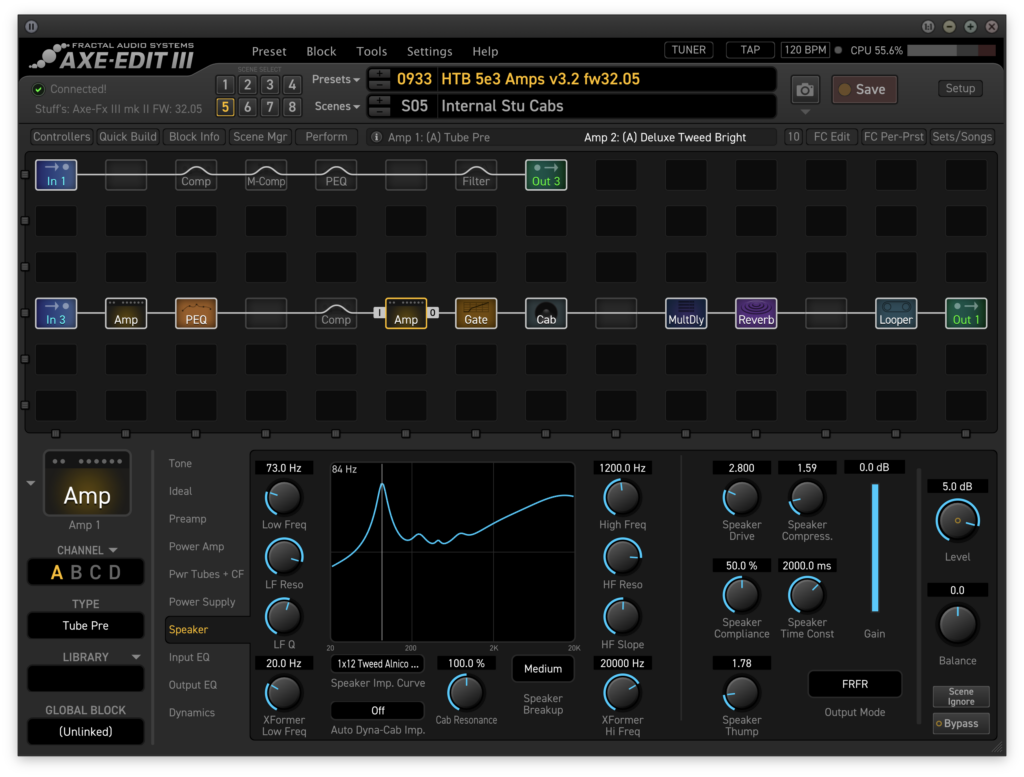
After some experimenting, I’ve decided to use the 1×12 Tweed Alnico Blue speaker impedance curve. To my ears, that brings out the best of my choice of IRs.
Three Places To Cut Excessive Low-End
While I’m building this signal chain, I’m also trying to overcome my bias for guitar tones that are a little too bass-heavy.
There’s a number of ways to do this in the Axe-FX 3 – yet another topic that deserves its own blog post. After experimentation, I’ve gone with the following approach:
- an always-on bass cut in the Tone Pre amp block,
- an additional optional low-end input cut in the Tone Pre amp block, and
- an optional tilt EQ between the tweed amp and the Tone Pre amp block.
I have applied a small bass cut in the Tone Pre amp block (the amp block that’s applying the final speaker impedance curve modelling):
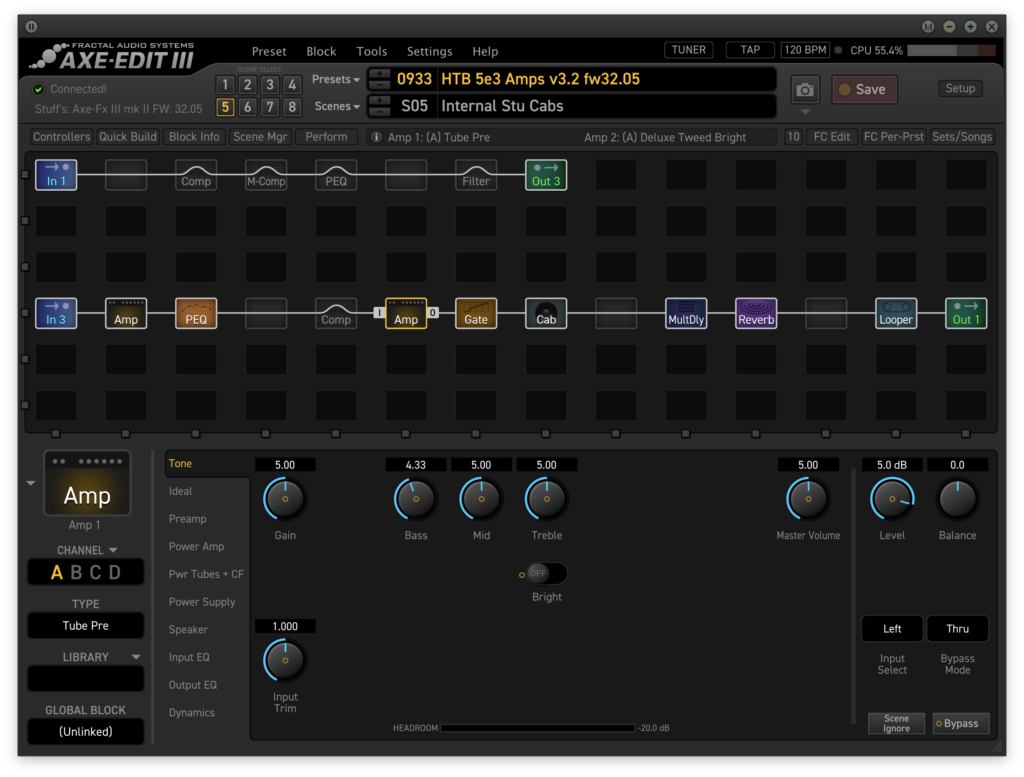
It doesn’t matter if I’m using my Tweed Deluxe amp, the Deluxe Tweed Bright amp model, or the Origin Effects’ Deluxe55: that bass cut is always there.
Speaking of the Deluxe55 … sometimes I need even more bass removed. That’s when I reach for the low cut control on the Tone Pre’s input. By default, no low cut is being applied, but I can easily adjust that from the front panel of my Axe-FX 3 by going to the Global Perform page:
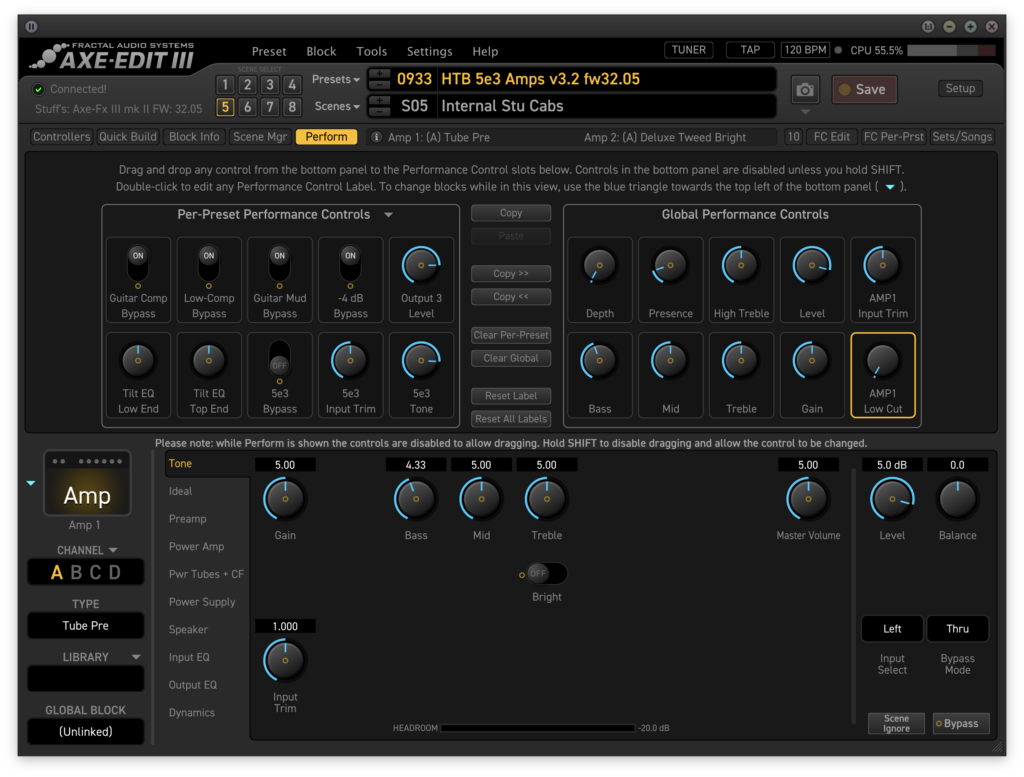
I’ve also got a tilt-EQ in the preset, just in case I want a different option. This is setup to cut low-end from around 164 Hz, or boost the upper mids around 1600 Hz.
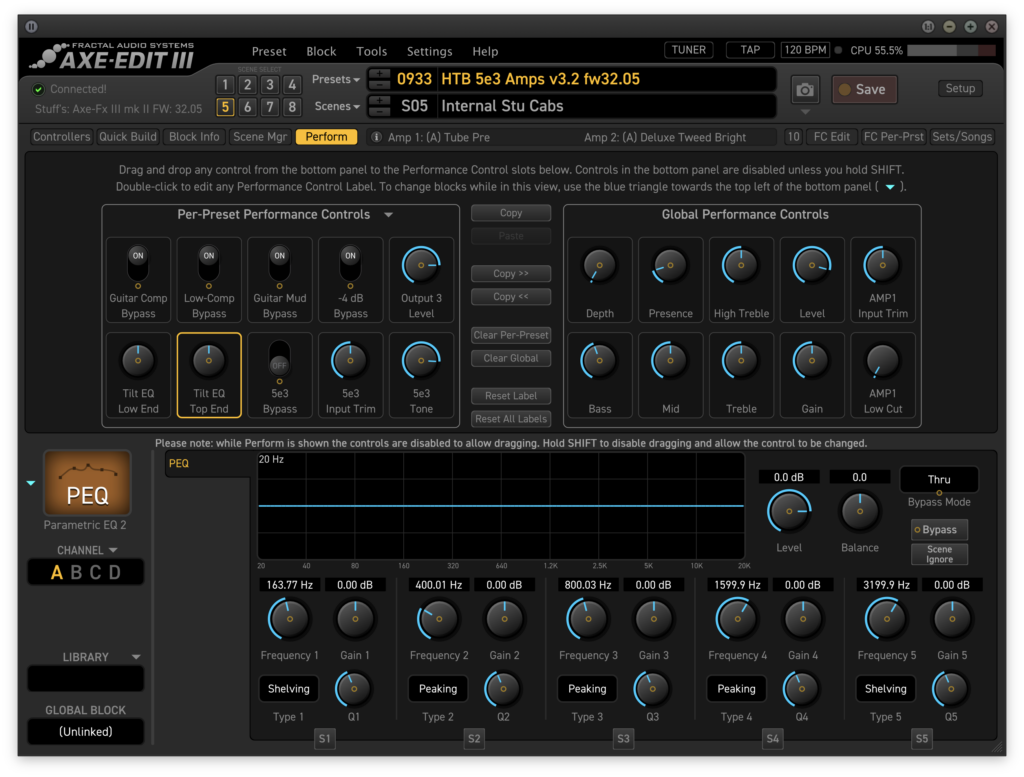
By default, the tilt-EQ block controls are set totally flat, so that they don’t affect the tone. I’ve put the controls into the Per-Preset Perform page for quick access from the front panel of my Axe-FX 3.
My Amp Settings, Not Chasing Famous Tones
I’m not someone who really chases tones used by famous artists. I’d rather leave questions about (say) “will it do the Neil Young Crazy Horse tone?” to those authors and content creators who are far more experienced with that.
Everyone’s got their own favourite settings for their Tweed Deluxe amp – precisely because there’s so many different ways to dial this amp in.
And – while I’m not sure I agree with this – forums
For me, the magic of a Tweed Deluxe amp lives in that space where the two channels are interacting. That’s where I find my clean tone, my low-gain rhythm tone, and a medium gain rhythm tone:
- INST @5 / MIC @10 for my clean tone,
- INST @4 / MIC @8 for my edge-of-breakup tone, and
- INST @3 / MIC @2 (with the channels jumpered) for my medium gain rhythm tone.
These are the kinds of tones that I use, and that I want to explore in tweed-tone pedals and amp models.
With And Without A Klon
While I personally prefer to put my Klon KTR in front of my Tweed Deluxe amp, let’s be honest: many people don’t run their amp that way, and it’s not the sound that tweed-tone pedals are chasing.
So I’m going to compromise and demonstrate this signal chain twice:
- once without anything in front of the amp,
- and once with my Klon KTR in front (in the classic clean-boost configuration).
Side By Side Comparisons
What You’re About To Hear
In this section, I’ve grouped the audio demos by guitar & how the amp is setup. You’ll hear both my real Tweed Deluxe amp and the Axe-FX 3 amp model next to each other.
If you just want to hear all of the Tweed Deluxe amp audio clips back to back (or just the Axe-FX 3 amp model clips back to back), you’ll find that further down this blog post.
Clean Strat-Style Tones
For these clips, I’m playing my PRS Silver Sky on the neck pickup. The guitar is going into the INST 2 input; makes it a lot easier to get a clean tone.
- I set the real Tweed Deluxe amp up with the INST volume on 5 and the MIC volume on 10.
- On the Axe-FX 3 model, the MIC volume doesn’t cancel out the INST channel as well as the real amp does. I had to dial in both volumes by ear until I got something fairly close.
Here’s how they both sound.
In reality, I’m almost always going to use my Klon KTR as part of my clean tones. So here’s how that sounds. All amp settings are unchanged.
Telecaster Low Gain Rhythm Tones
This is where I live on my real Tweed Deluxe amp: plugged into the INST 1 input, with INST volume on 4 and MIC volume on 8.
Let’s hear Jessie (my Fender 52 Reissue Telecaster) on its own first. I’m on the bridge pickup, with a small amount of neck pickup blended in:
Now let’s add in my Klon KTR. I’m using here in the classic clean boost configuration, which is often perfect for getting the most out of the 5e3 circuit design.
Nothing else has changed.
P90 Rhythm Tones
A Tweed Deluxe amp pairs very nicely with a P90 bridge pickup – especially if you find a P90 that’s brighter and a little more aggressive.
Here’s Desiré, the Gibson Les Paul Junior double-cut that I picked up late last year. I’m plugged into the INST 2 input, with the INST volume on 4 and the MIC volume on 8.
And here’s the same guitar and amp, just with my Klon KTR added in.
Les Paul Rhythm Tones
In these examples, I’m playing on the bridge pickup on GP, my Gibson Les Paul CR8. I’m plugged into the INST 2 input, with the INST volume on 4 and the MIC volume on 8.
First, let’s here it just as guitar straight into amp / amp model:
And now let’s here with my Klon KTR in front to tighten up the low-end that the amp sees, and to add a bit more brightness too:
Telecaster Medium Gain Rhythm / Jumpered 5e3 Tones
To finish off the audio demos, let’s go back to Jessie (my Fender 52 Reissue Telecaster), and use the amp in a different way.
Here, I’m plugged into the INST 1 input, and I have the INST 2 input plugged into the MIC 1 input. The amp is jumpered, just like you would with a classic four-input Marshall amp.
I’ve set the INST volume to 3, and the MIC volume to 2. Here’s how that sounds:
And here’s how the exact same signal chain sounds, just with my Klon KTR in between the guitar and the amp:
Reference Tone #1: Real Valve Amp – My Fender ’57 Custom Deluxe Amp
Why This Tone?
For many people, the sound of a real value amp is the standard.
Why Am I Using The Fender ’57 Custom Deluxe Amp For This Tone?
I’m using my Fender ’57 Custom Deluxe amp for the following reasons.
- It’s the 5e3 Tweed Deluxe amp that I own.
- It is a stock 5e3 circuit.
- I’ve played two, manufactured five years apart, and they sounded very similar.
- It’s probably the most widely-available Tweed Deluxe amp at the moment.
It’s not just the guitar tone that I have; it’s also the guitar tone that my readers could go out and buy for themselves if they so wished. I think that makes it a reasonable choice.
What Does It Sound Like?
Here’s all the audio demos that I’ve made with my real Tweed Deluxe amp. If you want to know more about each guitar or each amp setup, you’ll find those details further up this blog post.
Reference Tone #2: Vintage-Era Tone – The Axe-FX 3
Why This Tone?
Amp models and pedals that chase the 5e3 sound … they’re not chasing the sound of a Tweed Deluxe amp that’s been built recently. They’re chasing the sound of a Tweed Deluxe amp built circa 1955.
And I believe that they are a different sound to my Fender ’57 Custom Deluxe amp.
Why Am I Using The Axe-FX 3 For This Tone?
I’m using the Deluxe Tweed models in the Axe-FX 3 for the following reasons.
- It has a complete set of Tweed Deluxe models (bright channel, normal channel, and both channels jumpered), including how the channels interact with each other.
- It sounds like a vintage Tweed Deluxe amp.
- It takes pedals accurately.
- It’s the easiest to drop into my signal chain to replace my real Tweed Deluxe amp.
I honestly don’t know of a competing product that does all of the above.
- The UAD Fender 55 plugin has all the models, but can’t run where my real amp does my signal chain. (It only runs in the DAW.)
- The UAFX Woodrow’s model is incomplete (only models both channels jumpered).
- Fender’s Tone Master Pro unit is incomplete (only models both channels jumpered), sounds like my real amp (rather than a vintage amp), and doesn’t take pedals as well as the Axe-FX 3 does.
- Line6 Helix doesn’t include any 5e3 Tweed Deluxe amp models.
- Neural DSP Quad Cortex doesn’t include any 5e3 Tweed Deluxe amp models.
I think the only way that I could do better than the Axe-FX 3 would be to use an actual vintage Tweed Deluxe amp. (Not an option for me – yet another topic for a separate blog post!)
What Does It Sound Like?
Here are all the audio demos for the Deluxe Tweed models in the Axe-FX 3, all in one place so that you can hear how it reacts to different guitars and amp settings.
If you want to learn more about any of these demos, you’ll find all the details further up this blog post.
Final Thoughts
The thing that I like most about this work (the signal chain and Axe-FX preset) is that I’ve improved it by stripping it back.
The only things in the signal chain are what’s needed to get the sound through my amp and into my DAW. It’s just the essentials now. There isn’t very much left to tweak. That gives me confidence that this signal chain will have better staying power than my previous efforts.
The other thing that gives me confidence? I’ve also tested the exact same signal chain with several other amps. This blog post is already long enough, so I’ll cover that in a follow-up blog post.
One Reply to “#TweedTone: Dialling In Two 5e3 Tweed Deluxe Reference Tones For 2026”