I’ve just picked up a Marshall Studio JTM 20 ST20H amplifier.
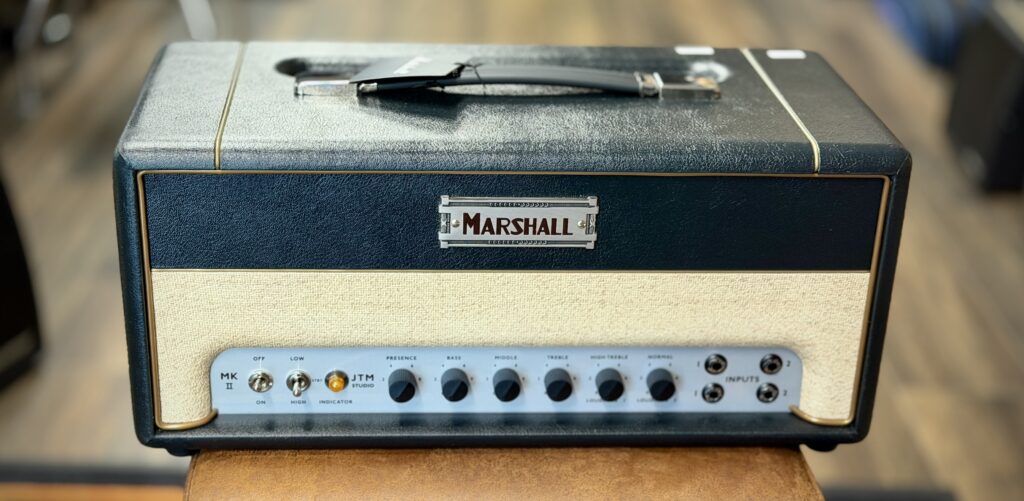
What do I think of it? Read on for my First Impressions.
What Did You Buy?
I bought a Marshall Studio JTM 20 ST20H amplifier head.
- “Marshall” is the manufacturer.
- “Studio” indicates that this amp is part of Marshall’s “Studio” series. The Studio series are smaller, 20W versions of Marshall’s larger famous amps.
- “JTM 20” is the model name. It indicates a 20W version of the legendary Marshall JTM 45 amp.
- “ST20H” is the model ID or model number.
- “head” indicates that this is just the amp itself; it doesn’t have an integrated speaker at all (ie, it isn’t a “combo” amp).
The amp itself is clearly labelled “JTM Studio” on the front panel, but Marshall’s own website refers to this as the “Studio JTM”. I’m going to call it the “JTM Studio” from here on in. Honestly, if Marshall wanted everyone to call the amp “Studio JTM”, they should have labelled it “Studio JTM” rather than “JTM Studio” 😜
Marshall’s very first amp was the JTM series, the most iconic of which was the Marshall JTM 45. The JTM 45 is one of the most famous rock amps of all time.
It’s also utterly impractical for home use, and too expensive for many folks.
In 2019 (just one year after the launch of the Marshall Origin), Marshall started releasing small, 20W versions of their classic amps, known as the ‘Studio” series. The JTM Studio itself came out in July 2023.
Just like the Marshall Origin, the JTM Studio features built-in power scaling (20W on full power, 5W on low power) to make it a little more home-player friendly.
That said, as I already have the equipment, I’m going to be using it through a load box, and running the output into my Axe-FX 3 hybrid rig.
I bought mine brand new from the fine folks at AStrings.co.uk.
Why Did You Buy It?
I’m in the process of producing my long-promised “Marshall Origin Long-term Review” and I wanted to know how my Marshall Origin compares to the JTM Studio.
One of the most difficult things to figure out is where the Marshall Origin really sits in Marshall’s line-up, especially since the launch of the Studio series in general and the JTM Studio in particular. Now that I have both the JTM Studio and the JMP Synergy module, I can explore that with a lot more confidence.
I haven’t bought it to use for just that one project, though.
From what I’ve read, the JTM Studio is also a pretty good pedal platform amp. I’m really looking forward to exploring that. If it checks out, expect to see me feature it regularly on here.
Why Did You Buy It Now?
Regular readers may recall that I’ve repeatedly said that I wasn’t going to buy this amp. What changed?
Well, it’s all thanks to Fender.
I’ve been saving up to buy a Fender Bassman Tone Master amp. However, just as I was about to go and order one from my local guitar store, Fender’s new management started to threaten other guitar makers.
My local guitar store (the wonderful AStrings.co.uk) lost out there, and honestly, I felt rotten about it. It’s not their fault that Fender have alienated part of the guitar community.
So I wanted to support them by spending the money there anyway. And what do I need? I need amps for reference tones – like this JTM Studio amp.
The other reason I got it now is that I’m almost ready to publish a blog article about the signal chain and Axe-FX 3 presets that I’ve built for my Marshall Origin 20H review. I say “almost” because I didn’t have enough confidence to actually hit the publish button.
Thing is – and this is entirely my own fault – once I publish that article, I’m kinda locked into that signal chain and Axe-FX 3 presets until I’ve written and published all of the blog posts for the Marshall Origin 20H review. In my mind, those blog posts only work as a set if they all share the same sonic foundation.
The last thing I want to do is hit “publish” on the signal chain blog post, and then discover that I need to tweak the signal chain five minutes later.
I’m going to use the JTM Studio to validate that signal chain and Axe-FX 3 presets.
A Big Thanks To Marshall
Just be clear: this isn’t a sponsored post in any way, shape or form. I bought this amp with my own money from my local guitar shop. I never talked to Marshall, I don’t know anyone there, and they probably don’t know that I exist.
This amp was a special order; my local guitar store doesn’t carry this amp normally. I have a possibly-wrong memory that Marshall themselves said in a YouTube video that they have a long lead-time on orders from guitar stores. (Basically, their factory is already maxed out trying to keep up with demand.)
I wasn’t expecting to see this amp for several months. And yet, Marshall got this amp out to my guitar store within a week.
If anyone from Marshall does read this: thank you for supporting my local guitar store. I really appreciate that.
What Does It Sound Like?
How Do You Have It Setup?
I’m running my JTM Studio into a loadbox (my Fryette PS-100 Power Station), and from there into my Axe-FX 3. My Axe-FX 3 is running a preset that I’ve built for my Marshall Origin amp.
I did try it through my Two Notes Torpedo loadbox first. I didn’t quite like the results, but that could easily have been down to my lack of knowledge about how to dial in this amp. I will revisit that soon.
I haven’t tried it through my real speaker cabs. This amp gets very loud very quickly, and probably isn’t a good choice for home use unless you run it through an attenuator.
I Struggled At The First Sitting
Right out of the box, several things immediately stood out: it sounded a lot thinner, darker and cleaner than I was expecting.
Even with the channels jumpered, I struggled to get the amp to gain up. This is not a fire-breathing dragon like the Marshall JMP!
Don’t get me wrong, this isn’t a complaint or a concern at all. My memory of the Marshall amps of my distant teenage years was that they were a lot cleaner than the amp tones people expect today.
This amp can rock out (which I’ll get to in a moment). I just didn’t know how to do it, and I didn’t figure it out during my first sitting with the amp.
Part of the thing with the “thin” sound is because I’ve just spent the week with my Tweed Deluxe amp, and the contrast in mid-range saturation between the two can be quite stark. With fresh ears the following day, it’s not as thin as I first thought.
I’m writing this blog post during only my third sitting with the amp, and I think it’s sounding pretty glorious now.
I Can’t Dime This Amp Through My Rig
The first thing I tried to do (to get the amp to rock out) was to dime it: put all the controls on max. That’s a bit of a troupe when it comes to older Marshall amps.
Unfortunately, if I do that with this amp into my load box, I get this very audible ringing sound. It’s loud, it’s horrible, and it doesn’t go away when I play.
At the time of writing, I don’t know what the cause is. I don’t know if it’s a problem with the amp, a problem with my load box, a problem with how I’ve configured my load box, or something else that hasn’t occurred to me.
I’m also not sure that I really care, to be honest. From the brief testing that I risked, this amp doesn’t sound very good when dimed – just like the Marshall Origin doesn’t. That poweramp saturation strips too much detail off of each note for my tastes.
The Middle Control Is The Secret To Rocking Out
I didn’t discover this myself; I went online and looked in the usual gear forums for how folks set up their Marshall JTM 45 amps.
Yes, the two channel volume controls play an important part in getting the JTM Studio to crunch up and rock out, for sure. But the Middle control is just as important.
Long story short: crank the mids to crank the gain. The main tradeoff is that, as I crank the Middle control, the amp loses touch-sensitivity.
Still Figuring Out How I Want To Setup The Amp For My Playing
I wouldn’t exactly describe this as a touch-sensitive amp to begin with. I’m used to being able to set-and-forget my amps, and rely on my picking dynamics alone to clean things up. I’m not one for adjusting the guitar’s volume control as I play. This amp might be about to change that.
With this amp, I haven’t found that sweet spot yet. It’s either too clean even when I dig in, or too far the other way and doesn’t clean up enough when I pick lighter.
It’s something that I need to set time aside to explore further.
Haven’t Tried It With Overdrive Pedals Yet
My pedalboard is currently setup for something else that I’m working on, and doesn’t have any drive pedals on there right now.
Does It Klon?
Yes. I can run my Klon KTR (in the classic clean-boost configuration) into my JTM Studio, and it sounds great.
Possibly a topic for its own blog post in the future 🙂
Other Discussion Points
The Black Control Knobs Look Cool But Are Very Impractical
With apologies to anyone who is visually impaired, I think the best way to explain the problem is with a couple of photos.
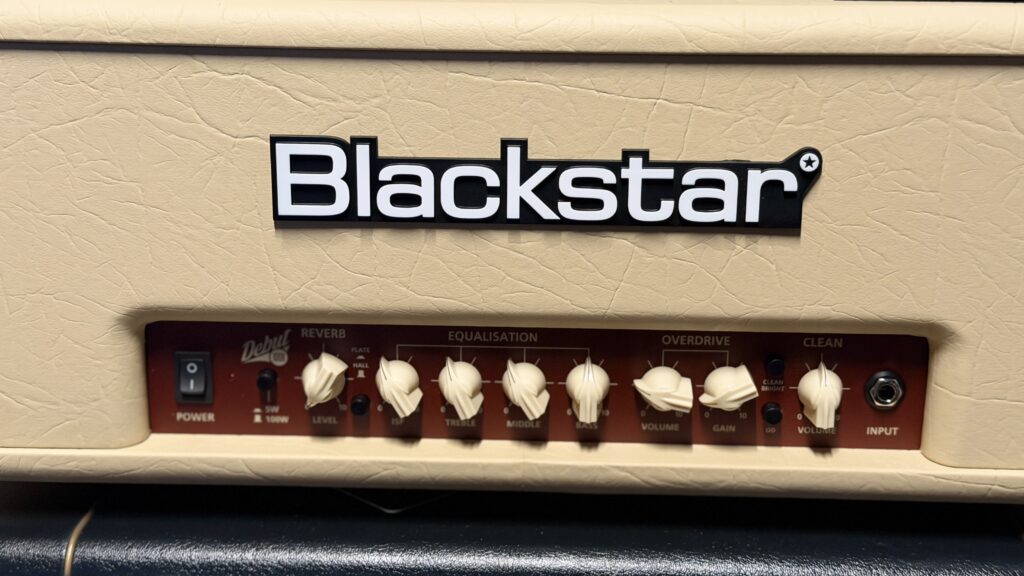
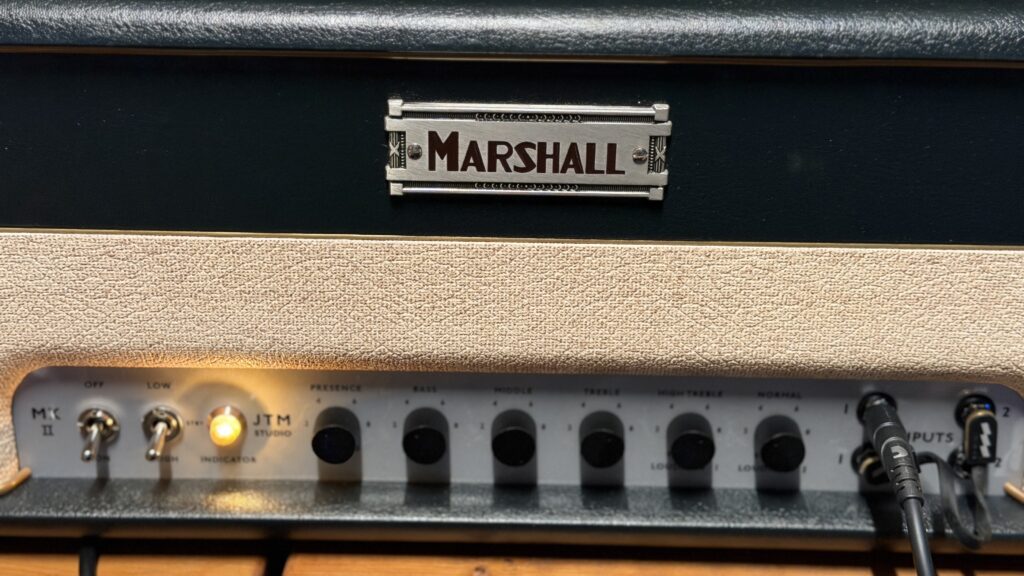
You tell me: what are the settings on each amp?
The first photo shows the front of my Blackstar Debut 100RH amp head. This amp uses control knobs that have a built-in pointer (often described as “chicken head” control knobs). The control knobs also have great colour contrast against the amp’s front panel.
As a result, it’s very easy to see what the settings are on my Blackstar amp.
Now look at the second photo, of the Marshall JTM Studio amp. This amp uses black control knobs that have no distinct visual indicator whatsoever. They simply appear as black circles.
In the right light, you might be able to notice that the surface of the JTM Studio’s control knobs has a raised ridge running through it. That makes it easy to physically touch the control and work out where it is set.
But these knobs are very impractical for seeing what the settings are.
I Love The Look Of This Amp
I think this amp is a real looker.
In particular, I love how this amp is visually distinctive to Marshall’s other Studio-series amplifiers. It has this whole retro vibe going on, and that really sets it apart from the Plexi Studio amp.
Here’s a photo showing the JTM Studio next to my Origin 20H.
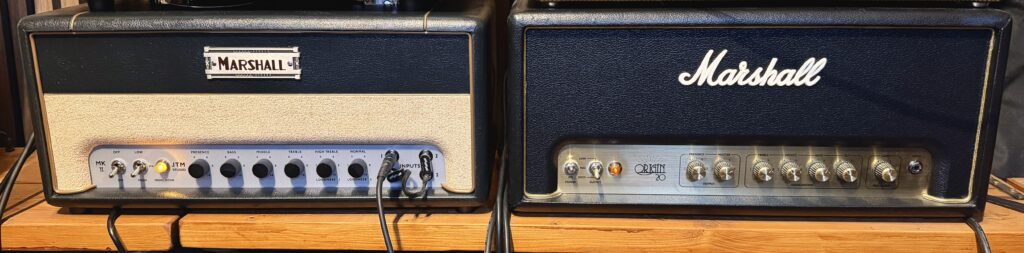
Both of these amps look great in their own right.
I haven’t been able to capture this on camera for you, but the JTM Studio’s tolex isn’t the same colour as the tolex on my Origin 20H. To my eyes, the tolex on the JTM Studio has a slight green tint to it.
The Piping On The JTM Studio Could Be A Little Neater
I have spotted what appears to be a visual quality control (QC for short) issue with my JTM Studio.
Take a look at this photo, which shows how the gold piping terminates on the front right of the amp:
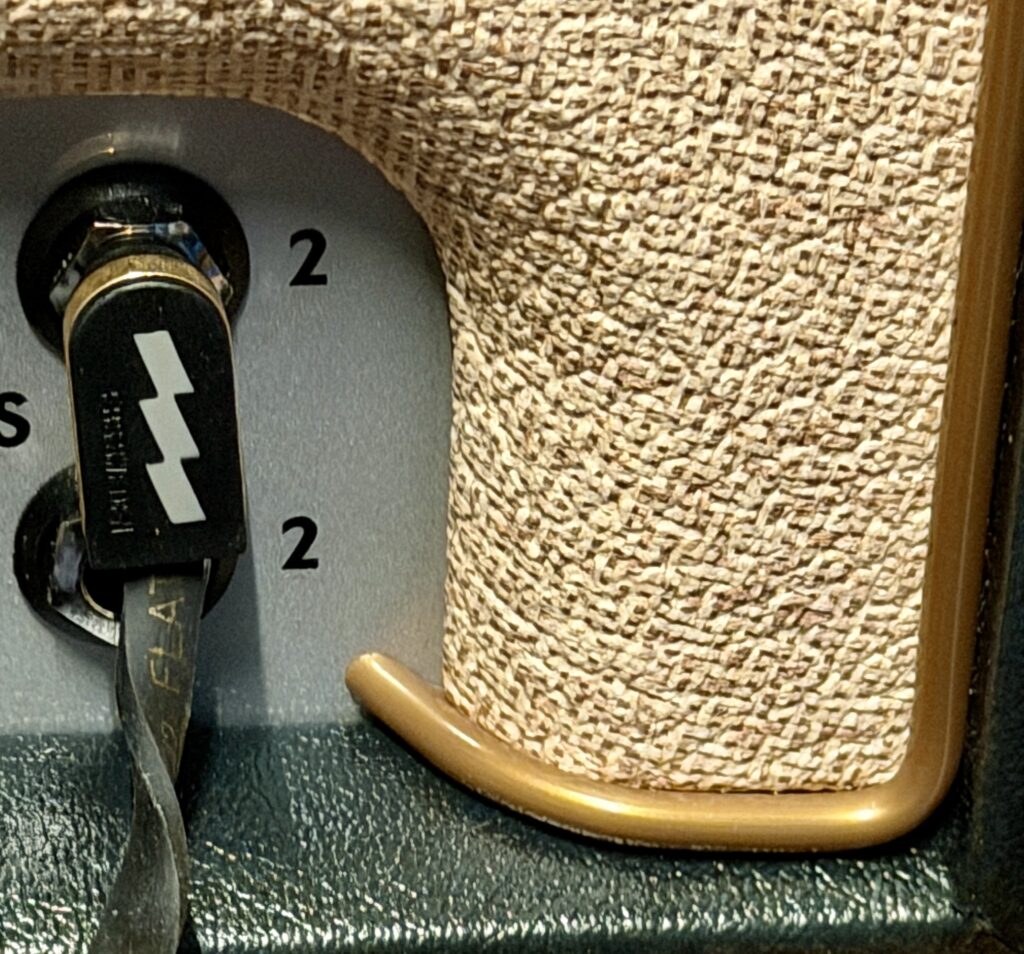
Is it just me, or does the piping just carry on after the grill cloth a bit too much?
(Oh – that photo also captures the green tint to the tolex that I mentioned earlier!)
Now compare that to this photo of my Origin 20H:
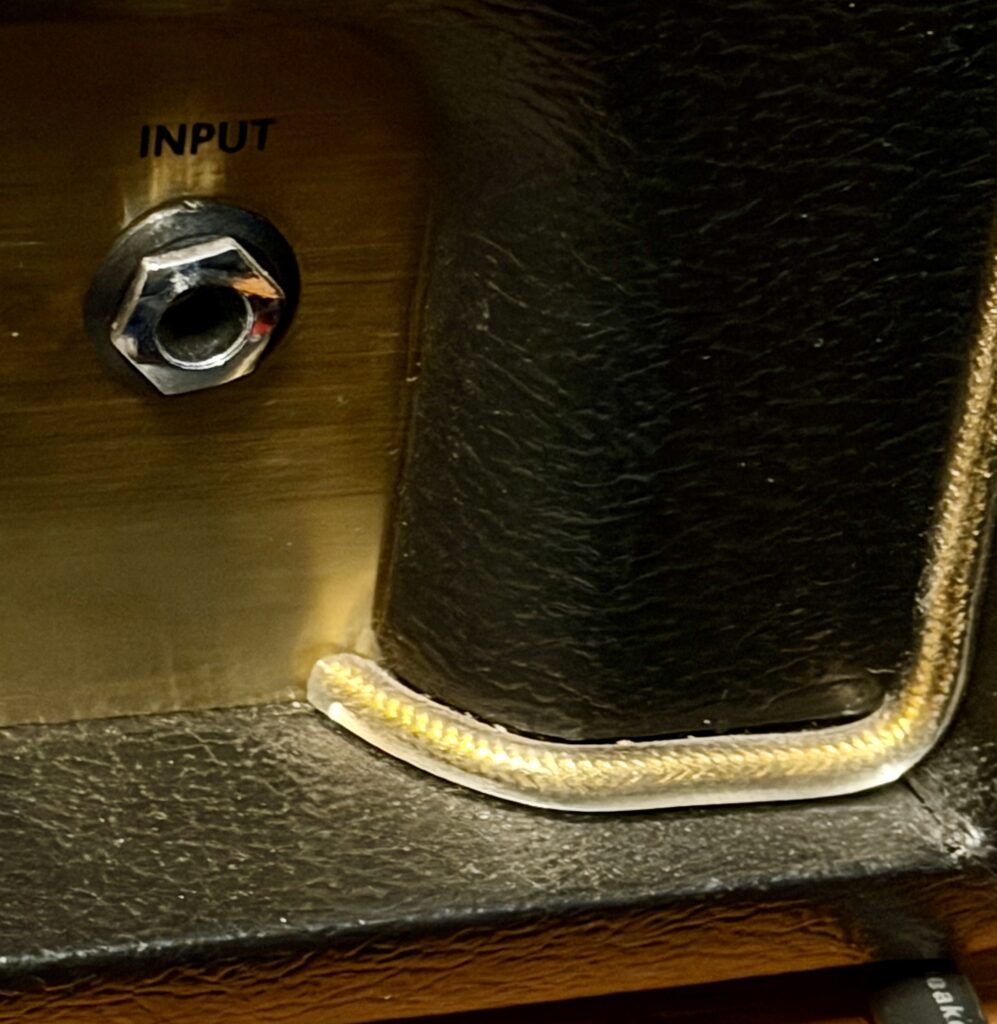
On my Origin 20H, the gold piping appears to be far more connected to the amp shell.
I’m fairly confident this is a QC issue, because the gold piping on the left corner of my JTM Studio doesn’t look like the right corner. It seems to be tucked in properly, just like on my Origin 20H.
It’s just a visual thing which I thought was worth pointing out.
I Wish I’d Bought This Amp When Prices Were Lower
Most of the time, I think it makes sense to wait on a potential purchase of a brand-new piece of gear. Maybe I’ll find a second-hand example at a price worth paying. Maybe I’ll realise that I don’t need to buy the item at all. Maybe the long-term reviews will turn up a serious problem that’s a showstopper for me.
This time? I do regret waiting.
With the full benefit of 20/20 hindsight, I should have realised back then that I was going to buy this amp eventually. I love my Marshall Bluesbreaker pedal, along with the Wampler Pantheon. This is a sound that I was always going to want to have, so that I can educate myself and explore it further.
If I’d bought this amp two years ago, I think I would have saved at least £100 – and probably closer to £150-£200. That’s a fair chunk of change.
To put things into context: before Marshall launched the Origin series and then the Studio series, we used to have to spend over £1000 to buy a great valve amp. So, even though prices have been forced up in recent years thanks to world events, these amps would still have been considered a real bargain only a few years ago.
Why Not Use The Axe-FX 3’s JTM 45 Amp Models Instead?
I have tried, but I didn’t get a result that I liked.
This is part of a general trend with me. I struggle to dial in an amp model in the Axe-FX 3 if I don’t know the amp in real life.
I consistently get better results out of my Axe-FX 3 when I’m using a model of an amp that I either own (like my Tweed Deluxe) or that I’ve spent a lot of time with (like the Deluxe Reverb).
I don’t know why this is the case. It’s not the Axe-FX 3, it’s definitely me.
Final Thoughts
I’m really glad that I bought this amp. I’m going to learn a lot from this amp, and have a lot of fun along the way.
It’s far too early to say whether or not this amp will become one of my main pedal platform amps for my blog posts. That is my hope. Watch this space 🙂