I recently bought a Blackstar TV-10A amp head.
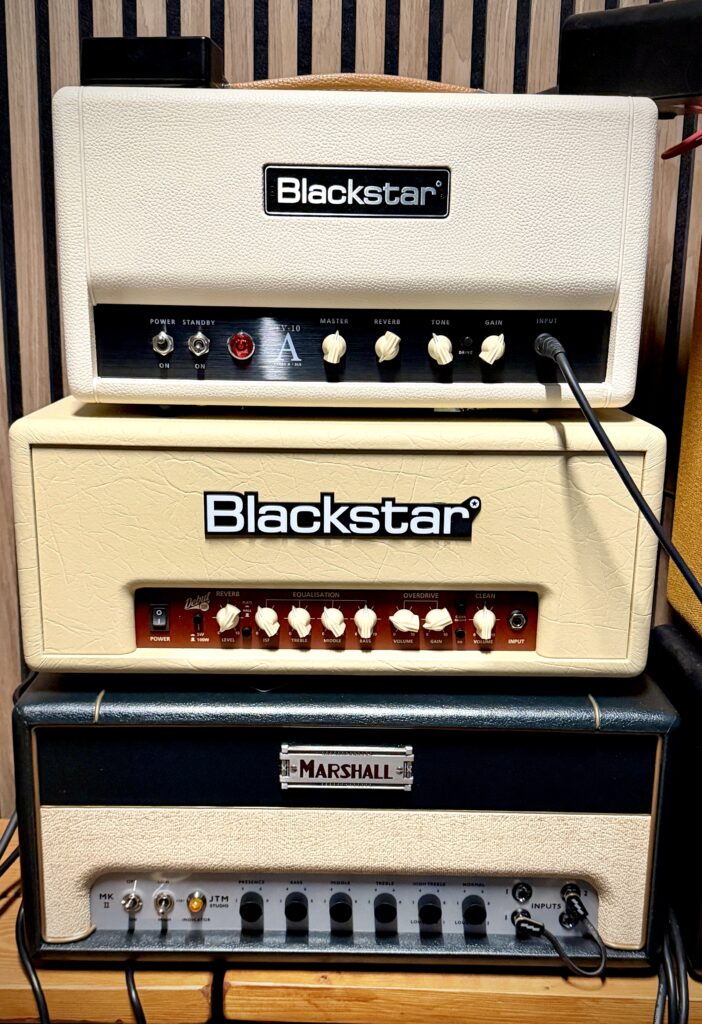
What do I think of it? Read on for my First Impressions.
What Did You Buy?
I bought a Blackstar TV-10A 10W 6L6 amplifier head.
- “Blackstar” is the manufacturer.
- “TV-10A” is the model number.
- “TV-10” indicates that this part of Blackstar’s TV-10 range of amps.
- The “A” in “TV-10A” indicates this is the “American” voiced amp.
- “6L6” indicates that this amp uses a 6L6 valve (or tube for Americans) in the power amp section.
- “head” indicates that there’s no speaker attached to the amp. Blackstar also sell the TV-10A as a combo amp. As far as I can tell, both the amp head and the combo share the same model number.
This is a simple, no-frills, affordable all valve amplifier head. It’s basically Blackstar’s latest take on a Fender-style clean tone. It’s the spiritual successor to their excellent Studio 10 6L6 combo amp. I don’t know whether the circuit is identical, or whether Blackstar has tweaked it further. If you know, leave a comment below please!
The main selling point of this amp is that it’s probably the cheapest all-valve pedal platform amp head that’s currently on the market and that you can walk into a guitar store to try. Many boutique drive pedals are designed in America, and inevitably are voiced primarily to go with Fender-style amps. This amp brings that kind of platform to the rest of us.
(Or, to put it another way, this is the home hobbyist / recording studio amp that I wish Fender would make.)
I bought it brand new from my local guitar store (the wonderful astrings.co.uk).
Why Did You Buy It?
I Miss The Blackstar Clean Tone
I’d originally planned to buy a Fender Tweed Bassman Tone Master amp in June. Recent events at Fender mean that I’m currently choosing to spend my money elsewhere.
I recently dug out my old Blackstar HT-1 combo amp for a blog post. Hearing that sound again, I’ve realised that I really miss the Blackstar clean tone.
Unfortunately, my old HT-1 doesn’t have enough output to work with the rest of my hybrid rig. I have to dime the amp and the line out of my load box to get a usable signal. With nowhere left to go, the end result has a plastic quality to the note attack. It’s a sound, for sure; it’s just not my sound.
What about an old HT-5 amp? I had a look on the second-hand market. The ones I found, I felt the asking price was too high for what the HT-5 is. Once you take their age into account too, I just felt it made more sense to pay a little bit extra and get an amp with a warranty.
(An HT-5 probably doesn’t have quite enough output either for me, alas.)
I used to own the Blackstar Studio 10 6L6. It was my first “proper” pedal platform amp. The TV-10A is its spiritual successor in Blackstar’s line-up – and it’s available as an amp head too 😍. (The Studio 10 6L6 was only available as a combo amp.)
Can’t You Get These Tones Out Of Your Axe-FX 3?
The Axe-FX 3 is a fantastic pedal platform – and it can do so much more too. So why buy another valve amp?
It’s the same reason I bought the Debut 100RH last year. This is the Home Tone Blog – not the Pro Tone Blog.
There are plenty of home hobbyists who run high-end amps or modellers, for sure. (I’m convinced it’s the home hobbyist market that keeps many of these manufacturers in business!) And I don’t plan to stop using the Axe-FX 3 on here.
But what about players who can’t afford that kind of gear? I want to make sure I cover that too, by adding in amps that are both more affordable and more obtainable too – like the Blackstar amps, and some of the cheaper Marshall heads that I already own.
I know that British amps can be a lot more expensive over in the USA. What do you use for affordable pedal platform amps over there? Let me know in the comments.
Did You Consider Getting The TV-10B Instead?
No, I didn’t. I needed a pedal platform amp – and that’s exactly what the TV-10A is for.
There are two main models in the TV-10 amp range:
- the TV-10A is the “American” voiced amp; and
- the TV-10B is the “British” voiced amp.
My understanding is that the TV-10B amp is Blackstar’s take on classic Marshall rock tones (the JTM 45 and Super Lead eras). I’ve already got several actual Marshall amps for that.
And, in all honesty, I’m far more into my Tweed Deluxe tones these days.
How Does It Sound?
Here’s an audio example for you:
Before I discuss it, here’s the reference tone to compare against, using one of my pedal platform presets for the Axe-FX 3:
To my ears, the TV-10A doesn’t sound exactly like the classic “blackface” Fender clean tone. I’d say that that the TV-10A sounds a little more modern: the frequency response seems a little wider (higher highs, lower lows).
There’s also a bit of a difference in the mid-range. I’m not sure if the TV-10A is slightly more mid-scooped, or if the TV-10A is simply mid-scooped in a different place.
So far, I think it sounds fantastic. It’s better than I expected. And it gives me a slightly different option to the excellent Fender amp models in the Axe-FX 3.
Attenuator / Load Box Choice Matters
When I first fired it up, I ran the TV-10A into my venerable (and affordable) Two Notes Captor load box. That … was not a good pairing. All the low-end disappeared, the mids sounded weird, and the top-end was too accentuated.
So I ran it into my Fryette Power Station PS-100 instead, and all of a sudden, there it was: the amp started to sound absolutely glorious.
No one attenuator can sound great with every single amp, even if it has switches we can use to change the reactive load box’s emulated speaker impedance curve. I’d love to see amp manufacturers either publish a list of recommended load boxes for us home players, or start to sell their own load boxes.
I also think it’s time for me to start hunting for an alternative affordable loadbox for my amps. I might be falling out of love with my Two Notes Captors …
How Does It Compare To The Blackstar Debut 100RH You Bought Last Year?
Regular readers may remember that I bought Blackstar’s solid-state pedal platform amp head – the Debut 100RH – late last year.
At the time, the TV-10A amp didn’t exist, so there was nothing to choose between.
Today, the Debut 100RH can be had for about half the price of the TV-10A. That price difference is going to be the deciding factor for some people – especially as you can record it at home without needing an expensive attenuator.
Here’s some audio of both amps for comparison purposes. Exact same signal chain; all I did was swap one amp for the other. (Oh, and I recorded the Debut 100RH from its effects send output; I did not use the speaker out into the attenuator.)
To my ears, the Debut 100RH works well – but the TV-10A is a little bit special as a pedal platform amp. What do you think? Let me know in the comments below.
I’m going to revisit this in detail in a follow-up blog post.
Any Niggles So Far?
Just one. I can’t stack any other amps on top of the TV-10A, because the amp shell (the wooden box that the amp sits in) is a lot smaller than the other amps that I own.
For the vast majority of people, the smaller physical size is probably a positive. It takes up less space in the house, less space in the car, and it fits better on smaller 1×12 cabs like the Victory V112s that I have.
Final Thoughts
I’m blown away by the TV-10A.
I was expecting the Studio 10 6L6 sound in a more convenient amp head format – and I would have been delighted with that. I think the TV-10A is better than my old Studio 10 6L6 was, and I think it’s a little bit special.
Why is no-one talking about this amp?
There were the usual YouTube demos when it first came out … and then it completely disappeared. I haven’t been able to find a single recent YouTube video about this amp. Not one.
I seem to be the only person who is writing about this amp too. My little blog already has two of the top four Google search results for the Blackstar TV-10A, and that’s before I publish this article. (The other two entries are product listings.)
I don’t understand it.
This has the potential to be the de facto standard pedal platform valve amp for us home hobbyists – the very thing that we all wanted 8 years ago when the Marshall Origin kick-started the affordable valve amp movement.
I say ‘potential’ only because I need a lot more time with the amp before I know for sure. And I need to run a wide variety of pedals through it first too.
Expect to see me feature this amp a lot more on the blog as I try to answer that question.
Exactly what I’m looking for (Debut 100H vs TV10A)
A big plus for TV10A head since more likely sound better in person, it’s also much better looking amp head lol. Some pluses for Debut 100H because it’s cheaper by half, lighter and slightly more versatile.
Question: Is Debut 100H really louder?
I can’t answer that question. I don’t use either amp with real speaker cabs, so I’ve never compared their volume.