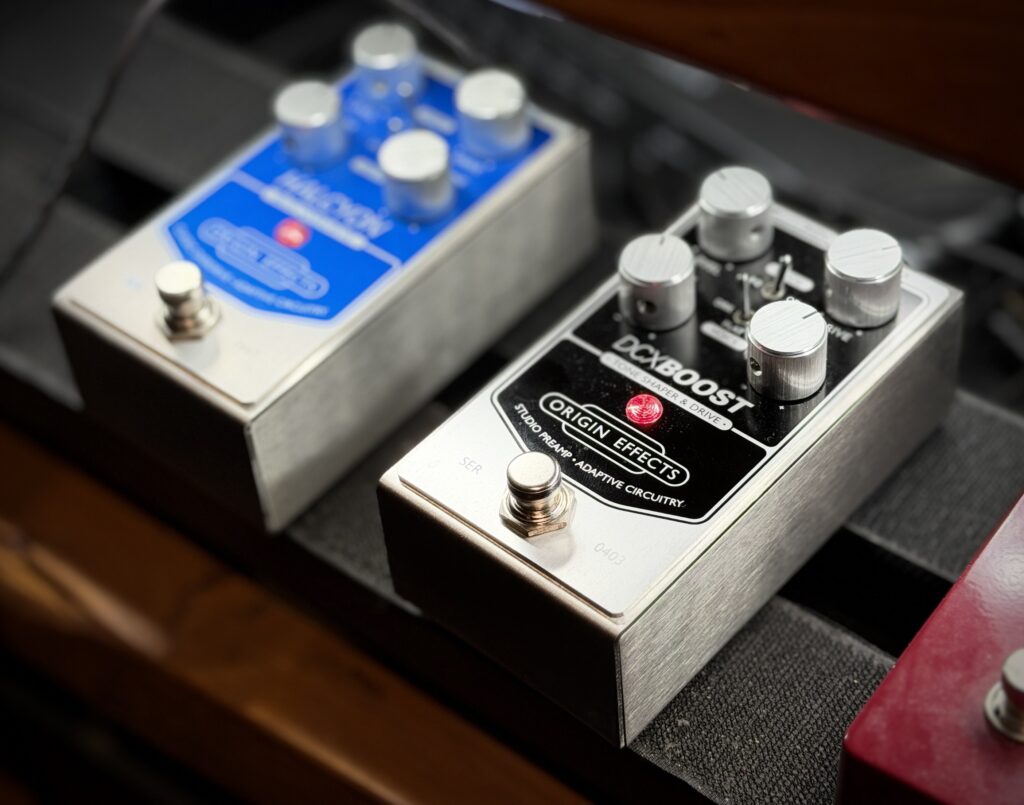
I recently bought a new (to me) Origin Effects DCX Boost.
What do I think of it? Read on for my first impressions.
What Did You Buy?
I bought an Origin Effects DCX Boost pedal.
- “Origin Effects” is the manufacturer.
- “DCX Boost” is the name of the pedal.
- “Boost” indicates that this pedal is designed to drive the rest of the signal chain harder in some way.
The DCX Boost is another pedal in Origin Effect’s series of pedals that are based on famous studio gear. In this case, it’s based on Universal Audio’s UAD 610 preamp circuit. It should be able to add colour to a guitar tone – as well as slamming the front end of an amp for more drive and saturation.
The pedal has two modes – EQ or OD – selected by a toggle switch on the front of the pedal. According to the manual:
- EQ mode is lower-gain, and the Origin Effects Adaptive Circuitry is active,
- OD mode is higher-gain, and the Adaptive Circuitry is off (which means that the treble roll-off is always on).
There’s also a three-way toggle switch on the front of the pedal, to control the amount of treble roll-off that is applied.
In both modes, there’s also a two-band active EQ. Each EQ control cuts when turned down below 12 o’clock, and boosts when turned up above 12 o’clock. Set at exactly 12 noon to make each EQ control be entirely flat / neutral.
I bought mine second-hand.
Why Did You Buy It?
One of my goals for this year was to explore the Origin Effects pedal lineup a bit more. The only caveat? I’m a bit “meh” about the Origin Effects pedals that I’ve previously tried, so I needed to wait until I managed to find a second-hand one within the budget I’d set.
Thankfully, these do turn up from time to time, and aren’t as sought after as the Halcyon series of drive pedals.
I went for the DCX Boost before the Halcyon Green because I reckon that I’ll use the DCX Boost a lot more.
My Rig Today
Today, I’m playing:
- Deadnote (my PRS McCarty 594)
- into my Axe-FX 3 (for the tuner)
- out to my pedalboard
- into the front of my Marshall Origin 50H amp head
- speaker out into my Fryette Power Station PS-100
- line out back into my Axe-FX 3 (for virtual cab, delay and reverb)
- out to my audio interface
- and into my DAW.
The Guitar
I’m using my trusty old PRS McCarty 594 for the audio examples today. Deadnote is completely stock, and I’m (mostly) playing in the middle pickup position.
On The Pedalboard
I’ve got the DCX Boost and Halcyon Blue (in MOD mode) in separate loops of my trusty Gigrig G2. The Gigrig G2 makes sure that a pedal cannot colour the tone at all when it’s not in use.
Amp and Cab
I’m running the pedals into my Marshall Origin 50H amp, and official Celestion Creamback 1×12 open-backed cab impulse responses.
Here are my settings on the amp:
- Treble at 6
- Mids at 4
- Bass at 4
- Tilt at 6
- Gain at 5 (aka 12 noon!)
- Presence at 2
- Master at 7
The amp is completely clean.
Delay, Reverb and Post-Processing
All the delay and reverb that you will hear is coming from my Axe-FX 3.
I have applied no post-processing in my DAW. I will have level-matched the audio before publishing it.
How Does It Sound?
My Base Tone
Let’s start with just the Halcyon Blue (in MOD mode) into the Marshall Origin 50H.
To my ears, it’s a nice thick, mid-heavy tone that probably works quite well for bluesy melodies. For the kind of chord-rich riffing that I like to do, not so much. There just isn’t enough note separation there.
Now – rightly or wrongly – I reckon the note definition is getting lost a little because the Halcyon Blue is overdriving on the low-end from my guitar. So let’s address that.
EQ Mode For Tone-Shaping
I’m in EQ mode on the DCX Boost, and I’m running the DCX Boost in front of the Halcyon Blue. I’ve turned the DCX Boost’s LF control down a little, to cut a little bit of low end before the signal reaches the Halcyon Blue.
Here’s how that sounds:
I’m hearing exactly what I was hoping to achieve: it still sounds like the Halcyon Blue in MOD mode, just with added note clarity. Any colour that the DCX Boost is adding is subtle compared to how strongly both the Halcyon Blue and the Marshall Origin are colouring the tone!
This might not seem like much of a tonal change – especially considering the retail price of the DCX Boost – but it’s exactly the kind of tool that I love to experiment with.
Let’s Hear The Three Voices
The three-way voice switch appears to be a powerful tool. If there’s a lot of treble, it’s quite a subtle effect. But if there isn’t much treble in the signal to begin with, the dark voice in particular is quite audible.
To show what I mean, here’s the same mini-riff played six times:
- bridge pickup, flat voice
- bridge pickup, medium cut voice
- bridge pickup, dark voice
- both pickups, dark voice
- both pickups, medium cut voice
- both pickups, flat voice
I’m not turning up the HF control on the pedal enough for the Voice switch to be a useful tool, in my opinion. But it’s nice to know that it’s there should I start doing so.
Not That Much Gain In EQ Mode
Just for completeness, here’s how the DCX Boost sounds in EQ mode with the gain cranked all the way up.
To get this to drive enough, I’ve had to switch to the bridge pickup on my guitar. I’ve also turned the LF control down a bit and the HF control up a bit to compensate for the tonal shift from the increased gain. Voice switch is in the Flat setting.
The recording sounds a little underpowered to me. It’s not just low-gain, but it’s also a little too flat – too lacking in dynamics, perhaps – for my taste. It almost sounds like it needs a boost of its own to come alive.
I’m sure that a sound like this does have a use, though. I think that I will have to try boosting this with another pedal in the future, to see what happens.
I’ve Spent More Time Using It As An Overdrive
The DCX Boost arrived shortly after my Marshall Origin 50H did, and I’ve had a lot of fun using the DCX Boost as an overdrive into my new (to me) amplifier.
Here, I’ve dialled in the pedal in OD mode. Gain is around 2 o’clock. Compared to the previous example, I’ve turned the LF control up a little to keep the same amount of warmth and thickness, and turned the output down a little because OD mode is louder than EQ mode. Voice is still in the Flat setting.
Oh – and I’m playing both pickups this time. I didn’t need to switch to the bridge pickup to get the DCX Boost to overdrive 🥳.
I don’t know if you can hear, but the OD here is starting to fuzz out around the edges of the note. That’s something that Tweed Deluxe amps can be made to do. It’s very interesting to get this from the DCX Boost like this.
I think I needed to turn up the HF control a little to compensate for the Adaptive Control circuitry in the pedal. Or maybe I just needed to turn the Presence control on my amp a little? Either way, I’d prefer this kind of drive characteristic with a slightly brighter tone overall.
Final Thoughts
Regular readers will be aware that I love stacking pedals together as a way to find my own sounds. I love having options, and the DCX Boost gives me new options.
What’s been a pleasant surprise is how good the DCX Boost sounds as an overdrive pedal into my Marshall Origin. The pedal’s vintage voicing seems to really suit the amp’s vintage voicing. This is a pairing that I’m going to have to explore a lot more.
And now I can’t help but wonder how the DCX Boost sounds in front of my Tweed Deluxe!