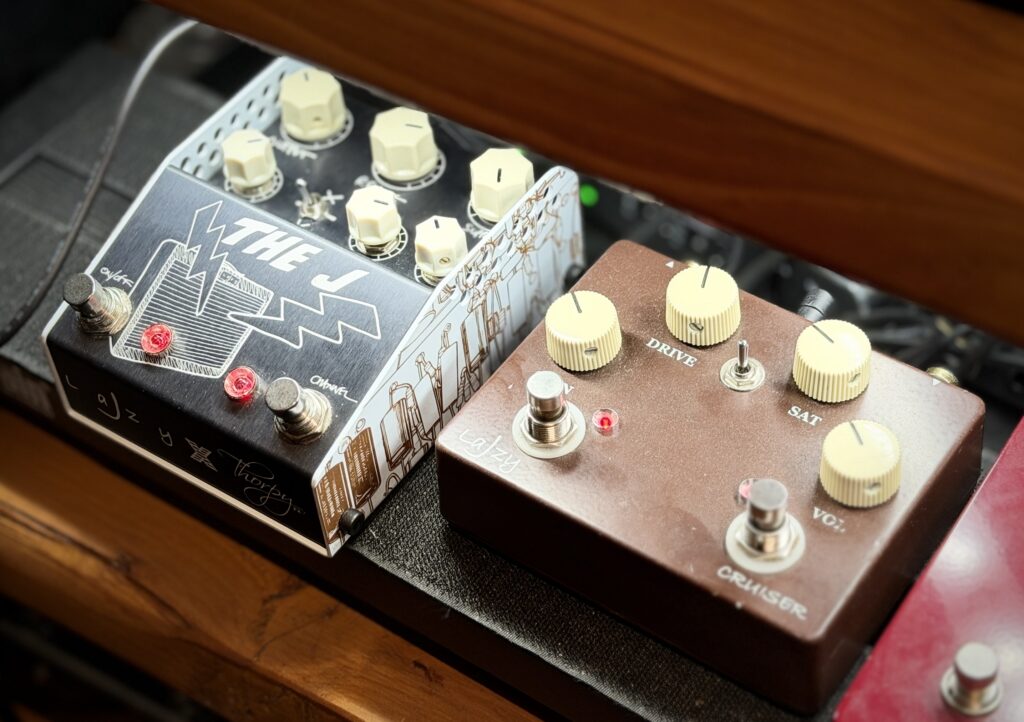
I recently picked up a new (to me) ThorpyFX The J “analog amp emulator” pedal.
What do I think of it? Read on for my first impressions. There’s a lot to talk about!
What Did You Buy?
I bought a ThorpyFX The J analog amp emulator pedal.
- “ThorpyFX” is the name of the pedal manufacturer.
- “The J” is the name of the pedal.
- “Analog amp emulator” is ThorpyFX’s own description of this pedal. It indicates that this pedal aims to re-create the behaviour of a guitar amplifier – in this case, a Lazy J 20 amp.
ThorpyFX designed this in collaboration with Jesse Hoff of Lazy J. It aims to capture the sound and feel of the Lazy J 20 – considered to be one of (if not the) finest modern Tweed Deluxe-style amplifiers.
Important to note: ThorpyFX’s manual does not claim that this is a recreation of the amp in pedal format. That will become very important when we get to my discussion points about this pedal.
I bought mine from the UK second-hand market.
Why Did You Buy It?
I collect tweed-tone pedals, and The J is (I believe) the only tweed-tone pedal that’s been released in the last few years.
I almost got one at launch, but I was put off by two things. I felt the retail price was too high for a pedal that – based on the product page and marketing at the time – didn’t emulate what I love about my real Tweed Deluxe amp.
I’ve finally found one on the second-hand market for a price where I’m willing to take a punt on this pedal. And I’m very glad that I did, because it does the one thing I want from a Tweed Deluxe amp-in-a-box pedal.
What Is The Lazy J 20?
The J chases the sound and feel of a Lazy J 20 amp. But what is it?
At its heart, a Lazy J 20 is a modified 5e3 Tweed Deluxe amp, normally fitted with a Celestion Blue speaker. Compared to the stock 5e3 circuit, the Lazy J uses 6L6 power tubes (for more headroom?), and a beefier tube for the rectifier to tighten up the low-end response, reduce amp sag and generally make the amp respond more immediately to the guitarist.
There are also three optional extras that can be included in a build: a built-in attenuator (known as VAC for Variable Attenuation Control), real spring reverb, and a tremolo circuit too.
The Lazy J 20 is widely considered to be one of the finest boutique Tweed Deluxe amps that are currently in production.
An Important Caveat
I haven’t played a Lazy J 20. Never even been in the same room as one. The closest I’ve come to hearing one is on early episodes of That Pedal Show. I think we can all agree that doesn’t really count!
I have played a Lazy J 10LC – it’s slightly lower power but hotter sibling – but I’ve never heard it in this room nor through my rig. One day! (It’s my bucket-list Tweed Deluxe amp.)
I do own a Fender ’57 Custom Deluxe amp (Fender’s modern Tweed Deluxe re-issue), and I run it with Celestion A-Type and Celestion Blue speakers. This isn’t the same as a Lazy J amp, but I’d argue that it isn’t fundamentally different either.
So while I can’t compare the pedal to a real Lazy J amp, I can compare it to the sound, feel and behaviour of a Tweed Deluxe amp.
I think that’s a reasonable comparison point.
My Rig Today
My signal chain is:
- guitar
- into the Axe-FX 3 (for the tuner)
- out to my pedalboard
- into a selection of amps
- speaker out into my Fryette Power Station PS-100
- line out back into the Axe-FX 3 (for virtual cab, delay and reverb)
- out to my audio interface
- and into my DAW.
In a couple of places, I’ll swap out the real amp and Fryette Power Station for an amp model in my Axe-FX 3. I’ll tell you when that’s the case.
The Guitar
My guitar today is my Fender 52 Reissue Telecaster, aka Jessie. This is my go-to guitar for playing through my Tweed Deluxe amp.
I’ll also throw in an audio example or two using Deadnote, my PRS McCarty 594. It’s the other guitar that I use a lot with my Tweed Deluxe amp. Main reason for using this is to let you hear the difference between single coils and low-output humbuckers with this pedal.
On The Pedalboard
I’ve got a number of pedals on my pedalboard today:
- my Klon KTR,
- DanDrive Tweedy 5B3,
- Lazy J Cruiser Deuce,
- Origin Effects Deluxe55, and
- ThorpyFX The J (the star of today’s blog post).
Each pedal is in a separate loop of my trusty old Gigrig G2, so that a pedal cannot colour the tone in any way when it is not in use.
The Amps and Cabs
For reasons that will become apparent as I talk through my first impressions of The J, I’ve ended up using several different amps today.
- my real Tweed Deluxe amp with Celestion A-Type and Celestion Blue impulse responses,
- my Marshall DSL20HR with Celestion V-Type impulse responses,
- my Marshall JTM Studio with Celestion Creamback impulse responses, and
- my Blackstar TV-10A with Celestion A-Type and Celestion Blue impulse responses.
I’ve deliberately paired each amp with a speaker that it’s typically sold with or used with, to try and get a sense of how The J might sound into each of them.
All of the real amps are running into my Fryette Power Station PS-100, with the reactive load switches set in the middle position.
I’m also going to use a couple of amp models in my Axe-FX 3:
- my HTB Vintage 15 preset, built for tweed-tone pedals, which uses a blackface Princeton model with Celestion A-Type and Celestion Blue impulse responses, and
- my HTB 65 Nashville preset, which uses a Deluxe Reverb model with Celestion V30 impulse responses.
Delay, Reverb and Post-Processing
All the delay and reverb that you will hear is coming from my Axe-FX 3.
I have applied no post-processing in my DAW. I will have level-matched the audio before publishing it.
Let’s Start With A Reference Tone
I think it would be very helpful to start by hearing my Tweed Deluxe amp. I’m going to record each guitar through the amp’s two INST inputs, so that we can hear the difference. We’re going to need that later on for comparison purposes.
First off, here’s my Telecaster into my Tweed Deluxe amp.
Amp settings for Jessie:
- INST VOL on 4
- MIC VOL on 8
- Tone on 9
And here’s my McCarty 594 into my Tweed Deluxe amp.
Amp settings for Deadnote:
- INST VOL on 4
- MIC VOL on 8
- Tone on 11
Hopefully you can hear that there’s a big difference between the two INST inputs on the amp. INST 1 definitely favours lower-output pickups like my Telecaster, while INST 2 (with it’s approx -6 dBa of built-in attenuation) is normally the better choice for humbuckers – even low-output humbuckers like the ones in my McCarty 594.
This Is An Overdrive Pedal, Not A Preamp
Take something like the Origin Effects Deluxe55. That pedal is designed as a preamp; it’s meant to run into a power amp or the FX return of your regular guitar amp.
You can run it into the front of an amp, but I’ve had no success (so far) in making it sound like a Tweed Deluxe that way.
Why have I started with the Origin Effects Deluxe55? Both of these pedals are trying to bring the Tweed Deluxe sound to pedalboards. But they do it in very different ways.
The J is designed to run into the front of your regular guitar amp, just like an overdrive pedal is. Just for completeness, I have tried it as a preamp too:
Yeah, definitely not a preamp pedal!
I wonder why ThorpyFX designed this to go into the front of an amp? Maybe this appeals to the bigger audience than a true preamp pedal would?
There’s just one problem with it …
My Results Are Very Amp-Specific
ThorpyFX say that The J “can work fantastically well with your existing amp … and it integrates easily into your current rig”.
There’s two ways to read that claim:
- The J will deliver a convincing Tweed Deluxe / Lazy J 20 amp sound with your existing amp.
- The J will sound fantastic with your existing amp.
As you’ll hear, point 2 isn’t in doubt: it does sound good. But can I make it deliver on point 1? That’s where I’ve struggled.
Let me show you what I mean.
On my Axe-FX 3, I’ve built a preset specifically for showcasing tweed-tone pedals. If I run The J into it, I think the end result sounds both too cold and too pronounced in the mid-range for my tastes:
Compare that to my DanDrive Tweedy 5B3 pedal into the exact same signal chain:
I’m hearing a big difference in both warmth and mid-range between the two pedals.
When I originally recorded this, I would have picked the DanDrive over The J every single time. Listening back with fresh ears … The J sounds a lot closer to my Tweed Deluxe amp than I realised.
ThorpyFX’s marketing says that this pedal was “tested worldwide during its development on the biggest of stages”. So what kind of gear might the pros have put it through?
One option is a Fender Deluxe Reverb Reissue (DRRI for short) fitted with a Celestion V30. That’s an amp and speaker combination that’s (reportedly) popular with professional musicians. So how does that sound?
I think it sounds really good. But does it sound like a Tweed Deluxe amp? Not to my ears.
While digital modelling helps home players like me build professional-style rigs, many of us are still going to be using physical amps. So let’s put The J in front of a bunch of them, and see what results I can get.
First up, let’s hear how The J sounds into my Marshall JTM Studio. It is an amp that’s often used as a pedal platform amp.
It also sounds really good to me, but it doesn’t quite sound like a Tweed Deluxe amp. The mids are just sat in the wrong place to me.
What about using a more affordable amp, like my Marshall DSL20HR?
Again, it sounds good, and it’s a sound that I want to come back and explore further one day. But also, again, the mids are sat in the wrong place, and they’re also too scooped with the way I’ve dialled in the amp today.
During the recording session, I found myself preferring the sound of running The J into my Blackstar TV-10A – a fantastic pedal platform amp.
To my ears, that needed a tiny bit of added mids between the amp and the virtual speaker cab, to give me a sound that puts a big smile on my face:
How does that compare to where we started from?
Listening back, the results aren’t the same – the real amp has even more mids than I’ve just dialled in, and I’m consistently dialling too much top-end today! – but definitely very usable. With more time and effort – and fresh ears! – I’m confident that I could get The J sounding much closer.
That’s how The J sounds into five different amps (two digital, three value amps). To my ears, each signal chain sounded quite different, and I don’t feel that there’s much I can do on the pedal itself to make each amp sound more like a Tweed Deluxe.
At the end of the day, going into the frontend of an amp puts any pedal at the mercy of how that amp and speaker pairing sounds.
That’s something I’ll be considering when I choose between the Deluxe55 and The J in future.
The Two Channel Controls Are Interactive 🥳
For Tweed Deluxe lovers like me, this feature is this pedal’s unique selling point, and the one feature that all other Tweed Deluxe amp-in-a-box pedals fall short on.
WTH, ThorpyFX?!? Why on earth isn’t this documented and being shouted from the rooftops?!? (At the time of writing, this isn’t mentioned on the product page, nor in the pedal manual.)
If you are unfamiliar: a Tweed Deluxe features four inputs, like a vintage Marshall amp does. Only there’s one crucial difference: the real amp’s two channels are interactive even when the inputs are not jumpered together. Turning up the volume on the inactive channel changes both the tone and the drive character.
For me, that’s where a lot of the magic is to be found in my Tweed Deluxe amp.
Regular readers may recall that one of my pet peeves with pedals that chase the Tweed Deluxe thing is that they never recreate the two interactive channels of a real Tweed Deluxe amp.
Some of them (like the UAFX Woodrow) emulate the sound of a jumpered Tweed Deluxe amp. Others, like the Origin Effects Deluxe55, emulate a range of Tweed Deluxe tones throughout the range of the Drive or Gain control.
This is a killer feature for The J to have.
This Makes The Channel Switching Foot Switch An Even Stranger Choice
The J has two foot switches:
- an on/off switch, and
- a channel selector switch.
The channel selector switch (effectively) emulates where the input cable goes on the real amp:
- red LED emulates plugging into INST 1 on a real Tweed Deluxe (aka the BRIGHT channel),
- green LED emulates plugging into MIC 1 on a real Tweed Deluxe (aka the NORMAL channel)
There’s no way to stop the two channels being interactive; at least, I haven’t found a way, and there are no documented internal controls.
So – unless I’m missing something – the channel selector switch is a set-and-forget option:
- decide which channel you want the guitar’s input to go into (BRIGHT or NORMAL),
- then set both channel controls to get the Tweed Deluxe tone you’re after.
Why is it set-and-forget? With The J set to my chosen input channel, it sounds glorious. Hit the foot switch to change channels, and it sounds anything but – just like on the real amp. The nature of the interactive controls means that channel switching only makes sense if I also change the channel controls too.
I think it would have made a lot more sense to have put the channel selector on a toggle switch. I can’t see any benefit to putting this onto a stomp switch.
What am I missing here? Why did ThorpyFX and Jesse go with this control layout? I can’t figure it out, sorry. If you can, let me know in the comments below.
I Haven’t Explored The 12AX7 Option
There is a toggle switch on top of the pedal. We can use it to switch between a Tweed Deluxe amp that has a 12AY7 preamp valve (the stock option) or a 12AX7 preamp value (for higher gain).
Normally, I love having options. And it definitely doesn’t hurt to have this. But there’s another feature that I would have rather had, given the choice.
The J Is Voiced More Like Input 2 On My Tweed Deluxe Amp
On a Tweed Deluxe amp, Input 1 and Input 2 act as high and low inputs. I plug my Telecaster into Input 1 (the high input, because its pickups have less output) and my Les Paul into Input 2 (the low input, because its pickups have more output).
In my testing, it seems that The J is closer to emulating a Tweed Deluxe’s Input 2 than it is to Input 1. That’s great for my Les Paul, but leaves my Telecaster sounding more anaemic than I hoped for.
To illustrate my point, let’s hear each guitar into Input 2 of my Tweed Deluxe, and then into The J. Don’t worry about the tonal differences; this is more about similar levels of drive. First, my Telecaster:
And then my McCarty 594:
Okay, I wasn’t expecting that. While the Telecaster’s quite close, there’s a big difference in both tone and overdrive level when I’m using my McCarty 594 😭
Even so, I think it’s still some way off from the amount of drive my real Tweed Deluxe produces when I’m plugged into Input 1:
I would have loved for there to be an Input 1 / Input 2 toggle switch somewhere on The J. I can get around it using a boost in front – which I’ll come back to shortly – but the convenience of an Input 1 / Input 2 toggle switch would have been 😘.
The Response And Supply Controls Work Well When I Treat Them As Interactive
The manual explains what these controls are, but doesn’t offer any advice about how to use them. So I’ll do my best to explain where I’m getting the best results from them.
First off: in my opinion, these controls are not there to adapt the pedal to an amp. Neither of them are traditional EQ controls. If The J doesn’t suit an amp, I’ve had no success in using these controls to change that.
But I have had a lot of success in using these two controls together to make The J sound nice and open, or more compressed like a Lazy J 10LC or my own Tweed Deluxe amp:
- At its maximum setting, the Supply control makes The J sound nice and open. This setting reminds me a lot of the Tweed Deluxe models in my Axe-FX 3.
- When I turn down the Supply control, this adds mid-range saturation and compression. The pedal breaks up a little earlier. This reminds me a lot of my own Tweed Deluxe amp and the Lazy J 10LC that I’ve played.
- If I turn the Supply control down below 12 o’clock, output volume and saturation both drop pretty quickly.
Once I’ve chosen where I want the Supply control to be, I then adjust the Response control to get the note attack to sit where I want it. I can turn it up a bit to add a bit more bite, or turn it down a bit if I want a bit more roundness to the note attack.
It did take me a day or two to work this out. I simply wasn’t able to really hear what these controls do well until I’d paired The J with the right amp.
These two controls are unique, and I’m delighted to have them. I love that I can get different flavours of Tweed Deluxe from the one pedal.
Does It Klon? Yes, But …
The J absolutely does take a Klon in front of it.
During the recording sessions, I felt that my Klon KTR into The J sounded too cold for my tastes. Listening back, I’m not hearing that anywhere near as much.
But I think that there’s an even better choice …
Just Get The Lazy J Cruiser Deuce To Go With The J
As well as making killer amps, Lazy J also makes a boost pedal for those amps: the Cruiser and the Cruiser Deuce.
Using the Cruiser Deuce in front of The J, I can add that missing signal back in to get my Telecaster into The J sounding closer to going into Input 1 of a real Tweed Deluxe amp. It makes up the difference really well, in my opinion.
And then there’s the Cruiser Deuce’s other party trick. I can use its Saturation control to thicken the mid-range. That can bring it closer in feel to my own Tweed Deluxe amp, or my memory of the Lazy J 10LC.
The one caveat is that the Cruiser Deuce does shave off a little bit of top-end (perhaps through compression?). I needed to tweak the Tone and Response controls on The J with the Cruiser Deuce on, to avoid the overall signal sounding too dull for my taste.
And, as you can hear, I ended up dialling in too much top-end (and not enough Saturation on the Cruiser Deuce) to nail the sound of my real amp.
In my opinion, pairing the Cruiser Deuce with The J is a no-brainer. It’s like adding a second channel to The J. Keep the Cruiser Deuce off for lighter, cleaner playing or more articulate passages, and then stomp on the Cruiser Deuce for thicker riffing.
The other thing I really like about this pairing? I feel like I’ve got very fine control over the resulting tone, and certainly more control than when I’m using my real Tweed Deluxe amp.
I’ve only had The J on the pedalboard for a couple of days, and already I just can’t imagine using it without the Cruiser Deuce.
Final Thoughts
My overwhelming feeling about The J is that it is a pedal full of most curious decisions that I don’t quite understand.
First, the most important thing: The J absolutely can give me 5e3 Tweed Deluxe tones. And not just any old Tweed Deluxe tones: it gives me those interactive channel controls that no other pedal does 😍. For that reason alone, this pedal is a keeper for me.
The other important thing: by using the Supply and Response controls together, I can get different flavours of Tweed Deluxe tone out of just one pedal. I can get something more vintage-like and open, or something more compressed and driven. For a Tweed Deluxe geek like me, this is a fantastic feature.
And it pairs superbly with the Lazy J Cruiser Deuce, so that I can push The J even closer to the Tweed Deluxe tones that I know and love from my real amp.
Designing The J to go into the front of an amp does offer a choice – and I’m all in favour of having more choices.
It’s just that my results are very amp-specific.
The Origin Effects Deluxe55 just doesn’t have that issue. But it requires either an amp with an effects loop, or something that can provide speaker cab emulation. It cannot work everywhere either.
For the life of me, I cannot figure out the utility of having channel switching on a stomp switch. In my mind, a secondary stomp switch is primarily there to activate a feature during a performance. Because the channels are interactive 🥳, it doesn’t make sense at all to switch channels mid-performance. I think this would have been more fitting on a toggle switch.
The pedal’s input level seems to be neither Input 1 nor Input 2 of a real Tweed Deluxe, but somewhere in-between, perhaps closer to Input 2. I would have loved to have seen an Input 1 / Input 2 toggle switch on the face of the pedal – but I accept that I’m probably in the minority there. (I imagine that most buyers will be chasing the sounds, not the usage experience, of a Tweed Deluxe amp.)
Overall, I’m left feeling very conflicted about this pedal, especially for what it costs. I’m hoping that’ll change as I spend more time with it.